
by Jon Kohler
Are you following the latest string of new diseases? If you love the outdoors, this one has its sights set on your family.
I understand if you haven’t kept up. My wife has had about enough of the news – either enough of hearing bad things or enough of me saying, “Yep, that’s right out of the Book of Ezekiel.” God put prophecy in the Bible, so we’d know the signs and not worry.
But this pestilence caught me off guard. This one is close to home – so close that I’ve been hesitant to write about what could change, and is already changing, my own lifestyle.
I broker and own recreational land, and I’m an advocate for the outdoors – especially for getting kids into it. My life’s work is to get more people out there, not fewer. So, I don’t say this lightly. But when I see us walking into harm’s way,
I’m going to be candid about it.
I teach my boys to watch for poisonous snakes, alligators, hornets and not to trust the neighbor’s pit bulls. Now, a lowly tick has risen to the top of that list.
The thought of becoming deadly allergic to meat and dairy – going into anaphylactic shock over fried backstrap at Thanksgiving dinner – scares the heck out of me.
My son has already had Lyme disease. I survived ehrlichiosis myself. We’re already two out of three on tick diseases. At least those can be cured, or subdued, with antibiotics.
I’m not sure yet what all of it means, and my thinking will surely change. But right now I find it curious that a new, incurable disease lands squarely on the readers of Woods ‘N Water and barely touches the lifestyle of the folks watching The View.
I study history and I study the outdoors. I’ve been watching this thing for some time now in other places – but now it’s in our woods, and the spread isn’t slowing down. Native Americans and early colonists never mentioned these tick-borne diseases. So, where did they come from?
A Curious Piece of Geography The first infamous tick illness, Lyme disease, was formally identified in 1975, in Lyme, Connecticut.
So where the heck is Lyme? It sits about 17 miles from the Plum Island Animal Disease Center – an 840-acre island a mile and a half offshore, where the U.S. Department of Agriculture, and later the Department of Homeland Security, have studied contagious livestock diseases since 1954. Interestingly, the island was chosen because the water around it was thought to be a natural barrier, reducing the risk of anything getting loose and reaching the mainland.
I don’t know what happened there. I’ll only tell you what’s on the public record. In 2019, Congress ordered the Department of Defense Inspector General to investigate whether the U.S. military experimented with ticks as biological weapons between 1950 and 1975. That is not a rumor off the internet. That is the United States Congress asking the question.
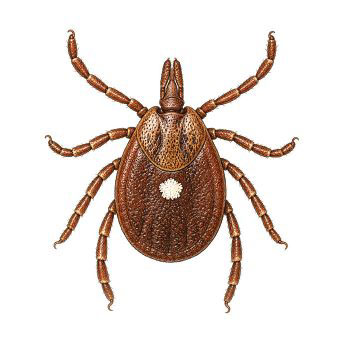 The most recent tick-borne disease, alpha-gal syndrome, wasn’t identified until around 2009 – just 15 years ago. On a hunch, I went looking for which county in America has the most cases of it.
According to the CDC’s own data, it’s Suffolk County, New York – more suspected cases than any other county
in the United States. Suffolk County is where Plum Island sits. Do your own research. But I’ll admit the first thing that came to mind was an old saying: this ain’t my first rodeo.
What Alpha-Gal Actually Does
Here’s what is known for certain. A lone star tick bites you and injects a sugar molecule called alpha-gal into your blood. That sugar is in every mammal we eat. Your immune system decides it’s a threat. And, from that day forward, when you eat red meat or dairy – beef, pork, venison, milk – your own body turns on you.
Not right away, either. Three to six hours later, in the middle of the night: hives, swelling, trouble breathing and sometimes full anaphylactic shock.
I’m told it can be as unforgiving as a peanut allergy. For the most sensitive, even the fumes off a grill can be enough. There is no cure – though some are working on a vaccine. And, there’s that rodeo
thought again…
If you still trust the CDC, here are their own numbers:
- As many as 450,000 Americans may have it.
- About 60 percent of them suffer full anaphylaxis.
- In a 2022 CDC survey, 42% of health-care providers had never heard of it.
- Another third had heard of it but weren’t confident diagnosing or managing it.
- Only 5% of providers said they were very confident treating it.
A Wrench in the Whole Plan Here’s what really gets me. Scripture tells us to be prepared. To be independent. To provide for our own. That’s how I try to live. For a lot of us down here, self-sufficiency isn’t just a hobby – it’s an instruction.
Alpha-gal throws a wrench right into the middle of it.
The cookouts. The barbecue. The freezer. The smoker. My family’s tradition of fried backstrap at Thanksgiving. All of it, gone in one tick bite.
And the people most exposed to this thing are exactly the people who spend their lives outdoors, trying to be self-reliant and trying to share God’s creation with their friends and their children. Us.
And Now They’ve Said It Out Loud
Here is the part I could not believe when I first read it…but then I could.
In 2025, the peer-reviewed journal Bioethics published a paper by two university professors arguing that because eating meat is morally wrong, and because people can’t be trusted to quit on their own, promoting the spread of tick-borne alpha-gal syndrome is – their words – “morally obligatory.”
They are not alone. A bioethicist at New York University, tied to the World Economic Forum, has been making the same case for over a decade. In a 2012 academic paper he proposed “human engineering” – artificially inducing an intolerance to red meat by turning your own immune system against it. Then, on video, he said the quiet part: “There’s this thing called the lone star tick, where if it bites you, you will become allergic to meat. So that’s something we can do through human engineering.”
But understand what has happened here. Serious people, at serious institutions, in peer-reviewed journals, have written down in plain English that a disease which takes away a man’s ability to eat what he raises and harvests would be a moral improvement.
The Sickest I’ve Ever Been
Ehrlichiosis – another lone star tick special – matched COVID for the sickest I have ever been in my life.
My doctors had no idea what was wrong with me. You know who figured it out? The late Lane Green, CEO of Tall Timbers. A fire man. He diagnosed me in conversation after a turkey hunt. Doxycycline knocked it out – after I had to talk my doctor into prescribing it.
And, here’s the kicker: that doctor, the one who follows CDC guidance to the letter, still doesn’t have it in my chart. To this day. As far as the medical system is concerned, it never happened.
That was 20 years ago. By the time my 12-year-old picked up Lyme, the doc tors knew more. But it raises a question I have been afraid to answer: at what point does it get too risky for a dad to take his boys into the woods?
When I was a kid, we worried about rattlesnakes and alligators – and you can do something about those. You can take precautions. You can see them coming. With a tick, it’s the elephant that can’t get away from the little mouse.
What Actually Works
So, what can we do? The one thing that has always worked. Fire.
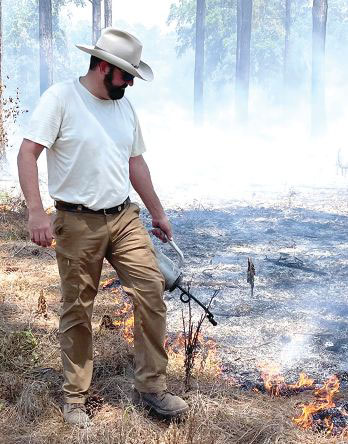
The same thing Lane Green – the Johnny Appleseed of prescribed fire – preached his whole career. I burn everything I can at Lick Skillet, every chance I get. Researchers comparing burned ground to unburned found that encounters with disease-carrying ticks were 98% lower on the land that burns.
…98%
But one burn won’t get you there. It takes the consistent, disciplined, every-two-to-three-year program you see on the plantations – not the five-plus-year rotation you see on a lot of state ground. And, the trick is to burn more than just the pine uplands. Get the fire into every corner it will go.
There’s another tool worth knowing about. In Connecticut and the other ground-zero Lyme states – the places
with no fire culture at all – they’re running what’s called a “4-Poster.” It’s essentially a corn feeder with roller applicators that coat a deer’s neck and ears with permethrin while it eats. Remember: DEET repels ticks; permethrin kills them. In studies, where enough stations were maintained over several years, tick populations dropped by 70% to 90%.
A lot of high-fence folks in Florida have known about these for years. One of my clients showed me his own improved design a decade ago. I took notice – but back then, ticks weren’t a life-or-death issue. They are now.
If the 4-Posters are as good as Connecticut says, then a statewide or national program – run the way we run screw-worm eradication – ought to be on the ta-ble down here. In the meantime, I’m putting them out at Lick Skillet. We already worm our preserve deer with ivermectin, and I know that helps.
They Sent My Boys Into It
My boys went on a school field trip to the Joe Budd Wildlife Management Area not long ago. I appreciate the outing – I want kids in the woods more than anybody.
They were covered in seed ticks. Many of you know exactly what I mean. Freshly hatched, by the hundreds.
Now, Joe Budd has a good burn program, and I’ll give them credit for it. But according to my boys – one of whom has his own custom drip torch – they don’t burn the grassy field right in front of the classrooms. They mow it. So the one patch of ground where the children actually stand was the one patch left unprotected.
It’s time our burn programs answered to something bigger than wildlife habitat. Bigger than wildfire suppression. Bigger even than making our land worth more. It’s time we burned for public health.
One Bite Cannot Take a People
So, here’s my dilemma, and I suspect it’s about to be yours.
I can spray my boys down with permethrin every time we go. But permethrin is like sunscreen – sometimes you get it right and sometimes you forget, and the ones most likely to forget are the ones with the most to lose. I cannot chemical my way out of this. Nobody can.
And, I will not answer that other question the way they would like me to.
I know exactly what their answer sounds like. Keep them home. Put them on a screen. Let the woods grow up thick and rank until nobody remembers what they were for. They have already written it down in a journal, in plain English – that a man losing the ability to eat what he raises might be a moral improvement.
Jesus was plain about this. “If ye were of the world, the world would love his own.” We are not of it. It does not love us. I made my peace with that a long time ago.
So, they said theirs out loud. Let me say mine.
Not on my watch.
We do not surrender the woods. We fix them. We are independent.
And here’s the thing – we are the only ones left who still know how. We never lost our fire culture. Connecticut would give anything for it. And, it may well turn out that the very thing our granddaddies did without thinking about it, the thing a lot of us still do every spring, is the thing that saves our grandchildren’s dinner table.
So, burn your ground, and burn it often. Burn more than the uplands – put fire in every corner it will go. Then go ask whoever manages the land your children walk on to do the same. Not just for the habitat. Not just for the wildfire.
For the kids.
One bite can take a lifestyle. It cannot take a people who refuse to give it up. Nobody is going to thank you for the work.
So, let me be the first. Thank you. Keep the torch lit.
 From murky farm ponds to pristine glacier-cut lakes and everything in between, Knox Daniels’ expertise stems from a lifelong fascination of water and the creatures that live in and around it. He recognizes and helps clients appreciate the value water features bring to a property. “My goal is to help buyers realize and sellers maximize the value different water bodies bring to a property, not only in a recreational sense, but also for social storm reasons.” After extensively traveling the country for collegiate BASS fishing tournaments, Knox graduated and worked for the Southeast’s finest fisheries and wildlife biologist, Greg Grimes. With Grimes’ company, AES, Knox managed many of the southeast’s finest private lake estate/impoundment properties, and learned the intricacies of upscale property management. Learning from Greg and other biologists, Knox honed in on the specific conditions and habitat needed for optimal gamefish growth in private lakes. He has also worked as a property manager on several thousand acres and for a commercial developer, facilitating the dirt work and builds of several apartment complexes, but his true passion has always been in the outdoors. “I’ve always had an insatiable fascination with ponds/lakes and am grateful to be able to help to place clients on the properties of their dreams and make their personal fisheries/wildlife goals reality with JKA.” – Knox Daniels
 Jason has been assisting landowners for the last 28 years in Georgia and South Carolina obtain achievements the owners did not realize were possible. His degree in Biology from Georgia Southern stemmed from the desire to know how things in nature work. His plantation roots began at just 16 years old outside of Albany, GA and the last 20 years were spent in the Lowcountry of South Carolina. His entire career has been spent developing a global approach to plantation management. That plan included sales. Sales is in Jason’s blood- his mom had a 45-year career as a real estate broker. After college, he chose to pursue his passion of making properties great. In 2011, Jason sold his first plantation. Since then, he has assisted buyers and sellers with over $20 million in sales while most of that time working as a full-time General Manager of a large Lowcountry plantation. Today, he is committed to using his unique skill set and experience to guide landowners through the many challenges of plantation ownership.
 Bruce Ratliff is a retired elected official (Property Appraiser Taylor County). Bruce brings years of experience in ad valorem tax knowledge. His property tax background gives JKA Associates & clients a unique insight into the complicated tax process. Bruce held several positions in the Florida Association of Property Appraisers, including member of the Board of Directors, President, Vice-President and Secretary, and served on the Agricultural & Legislative Committees for the Association. The real estate business has been part of Bruce’s life since childhood. His mother, Shirley Ratliff owned Professional Realty of Perry, Florida and his father, Buster owned Ratliff Land Surveying which Bruce was General Manager of before his political career.
 Hailing from a long line of outdoorsmen, Tim learned a great deal from his father and grandfather. He saw first-hand what it means to be a good land steward. He believes land is so much more than a place to hunt, fish, and grow timber or crops. “It’s an identity, a resting place, a safe haven and a way of life, said Tim.” Tim’s family ties to Alabama run deep. During his grandfather’s first term, Governor James was responsible for signing into law Alabama’s first state duck stamp which helped to ensure funding for the procurement, development, and preservation of wetlands for migratory waterfowl habitat. He also established Alabama’s lifetime hunting license, so it is no surprise that Tim is an avid outdoorsman with a keen eye as to how best to improve habitat for the greater good of its wildlife.
 With Madison County roots, Lori grew up on her family farm at Pettis Springs along the historic Aucilla River. A love of the land was instilled in Lori very early on by her father who was a local farmer. Lori understands the importance of good land stewardship and has witnessed first-hand how her own father, a former 2-term member of the Florida House of Representatives whose district encompassed many rural counties of the Red Hills Plantation Region, with a little bit of sweat equity, so lovingly worked their own family land. These are core values she carries with her today, and nothing gives her more personal satisfaction than to represent some of the south’s best land stewards.
 Cole’s dedication to land management lies in his family roots. As a fourth-generation timber expert, Cole’s earliest memories were spent with his father managing timber investments. With a degree in Food Resource Economics from the University of Florida, Cole is the epitome of an up-and-coming leader. He grew up with a hands-on approach to learning land management and conservation and has spent the last 15 years learning every angle of the real estate and forest industry. Cole is a member of the Florida Forestry Association, Red Hills Quail Forever, Southeastern Wood Producers Association and he uses this platform as an advocate for landowners and their land investments. His family has dedicated the past 60 years to providing landowners in North Florida and South Georgia with professional land management services focused on improving and protecting one’s forestland and wildlife investment. In fact, their family business, M.A. Rigoni, Inc., was one of the first to introduce whole tree chipping to the Red Hills Region.
 As a landowner of his own family farm, Lick Skillet, along with family land that has been passed down and enjoyed together at Keaton Beach for 40 years, Jon knows what it means to be a steward of the last best places. As a third-generation land broker with more than 30 years of experience in advising landowners in this niche, Jon is known for his innate ability to harvest a land’s unique intrinsic value. Touting several notable sales under his belt, Jon personally closed Rock Creek/Molpus – 124,000 acres of premium timberland at $142,000,000 – which was known as the largest timberland land sale in the Southeast for eight years running. He is a co-founding member of LandLeader and achieved the real estate industry’s highest honor, “2022 National Broker of the Year – Recreational Land Sales,” by the Realtors® Land Institute.