
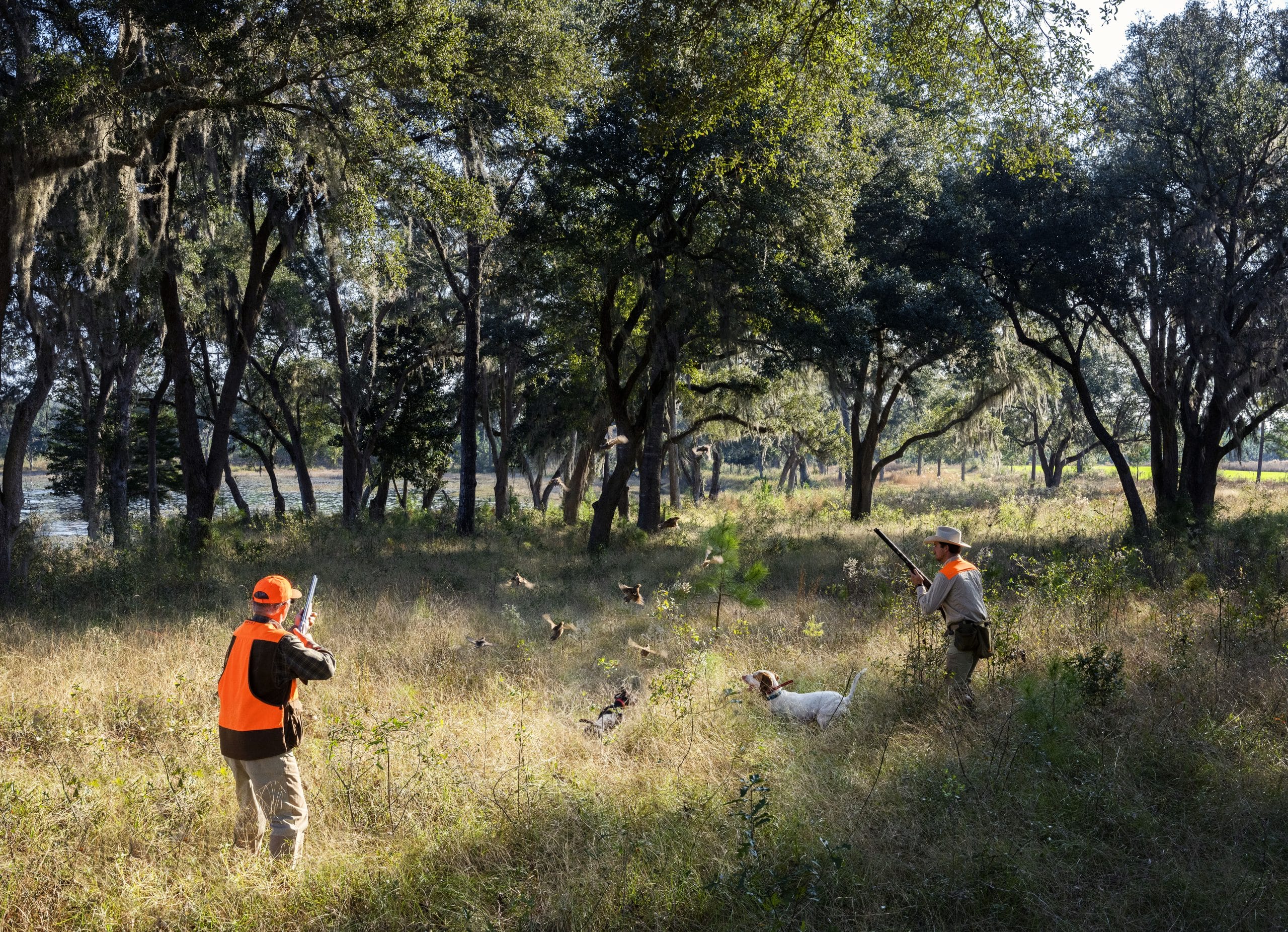
When it comes to enjoying the outdoors few things are like a covey flush. There’s nothing better than the beauty of the woods, working dogs, sporting camaraderie, and a fair test of one’s shooting abilities. Hitting the woods with friends and like-minded enthusiasts following closely by horse, wagon, or on foot.
What is it that makes quail hunting so addictive? Why do we strain our budgets training bird dogs, spending free time burning quail woods, and contracting forestry professionals to thin timber to a desired basil area? All of these steps are done as a commitment to the outdoors, prior to investing lots of time with boots on the ground on your favorite quail course.
An entire niche has been developed since 1888 at Jon Kohler and Associates. Real estate values that were already strong, now can run into the millions. Tall Timbers completed an economic impact study from both Albany and Red Hills showing astronomical dollar amounts spent annually just in those two belts. That study does not reflect the six-figure economic impact that Kohler and Associates see on a weekly basis.
We won’t just focus on Uber plantations though, because whether you are a high-net-worth individual or not, we understand small landowners across the fruited plain seek this same rush.
Why do they do this? Addiction to the quail is not much different from the addiction to birdwatching, or other outdoor pursuits. The quail addict always comes back to the covey rise.
One such quail addict is Kenny Barker, Regional Representative for Quail Forever (QF) in Florida, Georgia, and South Carolina. “When it comes to small private landowners our members have access to Farm Bill biologists that can come for a site visit and complete an assessment,” said Barker. “This will help landowners to understand how to do good things for quail habitat, which oh by the way is good for everything else in the woods too. The QF model has volunteers raising dollars, which they can spend on habitat projects, or outreach events like Field Days or Shooting Workshops.”
When the covey rises, dopamine and adrenaline rush through the body like a drug … God’s drug. The uncertainty that follows the sound of beating feathers, heading away at full speed on a mercurial and twisting flight path, produces a resounding sensory experience. “The landscape level quail management that is already in place with large landowners keeping prime habitat for decades is a wonderful example of what works,” said Barker. “Now QF is helping to fill in the habitat gaps between them, and I oversee 22 QF Chapters working hard towards that goal.”
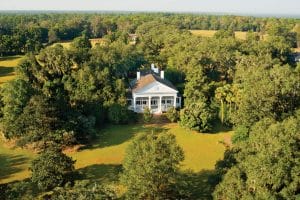
Greenwood Plantation, Conservation Deal of the Year
Type A personalities can certainly take it to the extreme. Jock Whitney’s quail hunting budget in 1964 was $4M a year across 18,000 acres. It had been handed down inside the family for so many generations, that when Kohler and Associates sold it, this was the first time it changed hands in 183 years. The property sale of Greenwood Plantation was so significant, that it named the “Conservation Deal of the Year.” Today’s colleagues like Paul Tudor Jones, and Mason Hawkins, work hard and spend fortunes to have the wildest coveys per hour on a consistent basis.
“The industry is growing. From managers, dog trainers, and new landowners the combination of the rush and addictiveness of a covey flush to the wholesome, really Biblical tenant of being a land steward there is something satisfying to a person’s core,” said Jon Kohler.
Shooting preserves can serve as the gateway drug to promote the sport of quail hunting and to grow the number of wingshooters. No one today knows more about doing things in a big way than Tim Smith at Southwind Plantation. “We offer wingshooters hunting in longleaf pines with lots of Southern traditions included,” said Smith. “We have a nearly 90-percent return business each year, partly because we know many of them on a first-name basis, but mainly because there may be more wild quail now than ever.”
Southwind Plantation is a 6000-acre Orvis-endorsed facility that offers 12 lodges and a 5-star restaurant. “We have 22 years of history offering quail hunts by mule wagon, horseback, and Jeep,” said Smith. “Our business went up by 25 percent during Covid, especially since Southwind could offer private lodging and dining, and really business has never dropped back off. We practice early release of 10,000-quail per year and manage our woods year-round.”
The Covid era led lots of folks to invest in bird dogs. It seemed like everyone bought a dog, including lots of English Cockers. Now those same folks not only want to hunt, but they need to hunt their dogs and they rely on the dog’s instincts to lead them towards many years of memorable quail hunting.
Dirt Road Dog Company in Climax, Georgia is well-known for their 15 years of experience breeding bird dogs. Owners Jessica and Derry Cannon share that Covid was a pivotal point in their timeline since demand for English Cockers went way up because customers wanted a hunting dog that was also a great family dog. A unique thing about the days of Covid is that it gave families the time required to spend with a puppy or started dog that is crucial to their outcome.
“Today what we are seeing in the progression of the puppies that went out during Covid and it brings us great joy,” said Jessica Cannon. “These dogs are people pleasers and they offer loyalty to everyone, including all the ladies that are going afield to hunt these days. Our kids live in a different world than the one we grew up in, and a bird dog in the house can keep them tuned in for good clean fun or even lessons in life. Lastly, even retirees have come into the fold looking for a dog like cockers that averages only 20 to 30 pounds.”
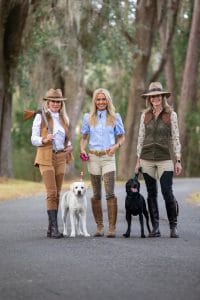
Proper upland clothing is essential for ladies today
Few people represent the upland lifestyle better than Kevin and Kathleen Kelly of Kevin’s Outdoor Gear and Apparel in Thomasville. Quail hunting comes with its own fashion and at Jon Kohler and Associates, this is our year-round uniform, except maybe for the Cowboy Hat. “I’m not sure where Jon found his cowboy hat, but I know he wears a vest from Kevin’s to go with it,” said Kathleen Kelly. “Whether it’s a vest, shooting shirt, or briar pants our in-house design team works hard to make our products unique. We just completed a new lady’s shirt for Fall of ’24 and our new men’s shirt, a British khaki quail design with orange shooting patch is flying off the shelves.”
“Our poplin shooting jacket is super lightweight, because nobody really wants heavy clothing much anymore, and the trend is towards performance fabrics too,” said Kelly. “Our 5-pocket pant for men is a daily standard for many, and we offer it from slim to husky so they can all look good in them too. Gokey boots and American-made and are new to Kevin’s this year, and they offer a great value for customers.” Don’t forget to visit Kevin’s Game Fair in the Fall, with the proceeds to benefit Tall Timbers.
A lot of things in this country have seen their best days come and go, but for quail hunting, the best days in the present, and they are only getting better. “It’s all about a 6-ounce bird that is as addictive to a recreational upland hunter, and those who love God’s great outdoors, as any man-made drug ever created,” said Kohler. “If this current rush of quail hunting fever results in restoring heritage and adding more habitat to the landscape, then it’s a win for sportsmen and for bobwhites.”
 From murky farm ponds to pristine glacier-cut lakes and everything in between, Knox Daniels’ expertise stems from a lifelong fascination of water and the creatures that live in and around it. He recognizes and helps clients appreciate the value water features bring to a property. “My goal is to help buyers realize and sellers maximize the value different water bodies bring to a property, not only in a recreational sense, but also for social storm reasons.” After extensively traveling the country for collegiate BASS fishing tournaments, Knox graduated and worked for the Southeast’s finest fisheries and wildlife biologist, Greg Grimes. With Grimes’ company, AES, Knox managed many of the southeast’s finest private lake estate/impoundment properties, and learned the intricacies of upscale property management. Learning from Greg and other biologists, Knox honed in on the specific conditions and habitat needed for optimal gamefish growth in private lakes. He has also worked as a property manager on several thousand acres and for a commercial developer, facilitating the dirt work and builds of several apartment complexes, but his true passion has always been in the outdoors. “I’ve always had an insatiable fascination with ponds/lakes and am grateful to be able to help to place clients on the properties of their dreams and make their personal fisheries/wildlife goals reality with JKA.” – Knox Daniels
 Jason has been assisting landowners for the last 28 years in Georgia and South Carolina obtain achievements the owners did not realize were possible. His degree in Biology from Georgia Southern stemmed from the desire to know how things in nature work. His plantation roots began at just 16 years old outside of Albany, GA and the last 20 years were spent in the Lowcountry of South Carolina. His entire career has been spent developing a global approach to plantation management. That plan included sales. Sales is in Jason’s blood- his mom had a 45-year career as a real estate broker. After college, he chose to pursue his passion of making properties great. In 2011, Jason sold his first plantation. Since then, he has assisted buyers and sellers with over $20 million in sales while most of that time working as a full-time General Manager of a large Lowcountry plantation. Today, he is committed to using his unique skill set and experience to guide landowners through the many challenges of plantation ownership.
 Bruce Ratliff is a retired elected official (Property Appraiser Taylor County). Bruce brings years of experience in ad valorem tax knowledge. His property tax background gives JKA Associates & clients a unique insight into the complicated tax process. Bruce held several positions in the Florida Association of Property Appraisers, including member of the Board of Directors, President, Vice-President and Secretary, and served on the Agricultural & Legislative Committees for the Association. The real estate business has been part of Bruce’s life since childhood. His mother, Shirley Ratliff owned Professional Realty of Perry, Florida and his father, Buster owned Ratliff Land Surveying which Bruce was General Manager of before his political career.
 Hailing from a long line of outdoorsmen, Tim learned a great deal from his father and grandfather. He saw first-hand what it means to be a good land steward. He believes land is so much more than a place to hunt, fish, and grow timber or crops. “It’s an identity, a resting place, a safe haven and a way of life, said Tim.” Tim’s family ties to Alabama run deep. During his grandfather’s first term, Governor James was responsible for signing into law Alabama’s first state duck stamp which helped to ensure funding for the procurement, development, and preservation of wetlands for migratory waterfowl habitat. He also established Alabama’s lifetime hunting license, so it is no surprise that Tim is an avid outdoorsman with a keen eye as to how best to improve habitat for the greater good of its wildlife.
 With Madison County roots, Lori grew up on her family farm at Pettis Springs along the historic Aucilla River. A love of the land was instilled in Lori very early on by her father who was a local farmer. Lori understands the importance of good land stewardship and has witnessed first-hand how her own father, a former 2-term member of the Florida House of Representatives whose district encompassed many rural counties of the Red Hills Plantation Region, with a little bit of sweat equity, so lovingly worked their own family land. These are core values she carries with her today, and nothing gives her more personal satisfaction than to represent some of the south’s best land stewards.
 Cole’s dedication to land management lies in his family roots. As a fourth-generation timber expert, Cole’s earliest memories were spent with his father managing timber investments. With a degree in Food Resource Economics from the University of Florida, Cole is the epitome of an up-and-coming leader. He grew up with a hands-on approach to learning land management and conservation and has spent the last 15 years learning every angle of the real estate and forest industry. Cole is a member of the Florida Forestry Association, Red Hills Quail Forever, Southeastern Wood Producers Association and he uses this platform as an advocate for landowners and their land investments. His family has dedicated the past 60 years to providing landowners in North Florida and South Georgia with professional land management services focused on improving and protecting one’s forestland and wildlife investment. In fact, their family business, M.A. Rigoni, Inc., was one of the first to introduce whole tree chipping to the Red Hills Region.
 As a landowner of his own family farm, Lick Skillet, along with family land that has been passed down and enjoyed together at Keaton Beach for 40 years, Jon knows what it means to be a steward of the last best places. As a third-generation land broker with more than 30 years of experience in advising landowners in this niche, Jon is known for his innate ability to harvest a land’s unique intrinsic value. Touting several notable sales under his belt, Jon personally closed Rock Creek/Molpus – 124,000 acres of premium timberland at $142,000,000 – which was known as the largest timberland land sale in the Southeast for eight years running. He is a co-founding member of LandLeader and achieved the real estate industry’s highest honor, “2022 National Broker of the Year – Recreational Land Sales,” by the Realtors® Land Institute.