
by Walter Hatchett and Brett Bryan
 A friend recently wrote this on a chalkboard at our hunting lodge, and it resonated with us. Having grown up on a farm and always enjoying working the land, our passion for land management and hunting drives us to cultivate food plots that benefit wildlife, especially deer, turkeys, ducks and even elk.
Through decades of experience and having worked with several clients, including David Morris, renowned biol-ogist and founder of Tecomate, as well as Tecomate Biologist Mark Newell, we’ve discovered that factors like soil type, weather, timing of planting and deer herd density significantly influence food plot success.
Having managed recreational properties in North Florida, South Geor-gia and even in Colorado and Wyoming, we’ve learned that the effort you invest in your land directly impacts the results you achieve.
As we look ahead, it’s essential to start preparing in the springtime for the upcoming hunting season. We conduct a lot of scouting and stand setups in early spring, right after the season ends. It’s much easier to spot trails, old scrapes, rub lines and bedding areas when the trees aren’t fully leafed out. We use this information to adjust our stand locations and plan our entry and exit routes.
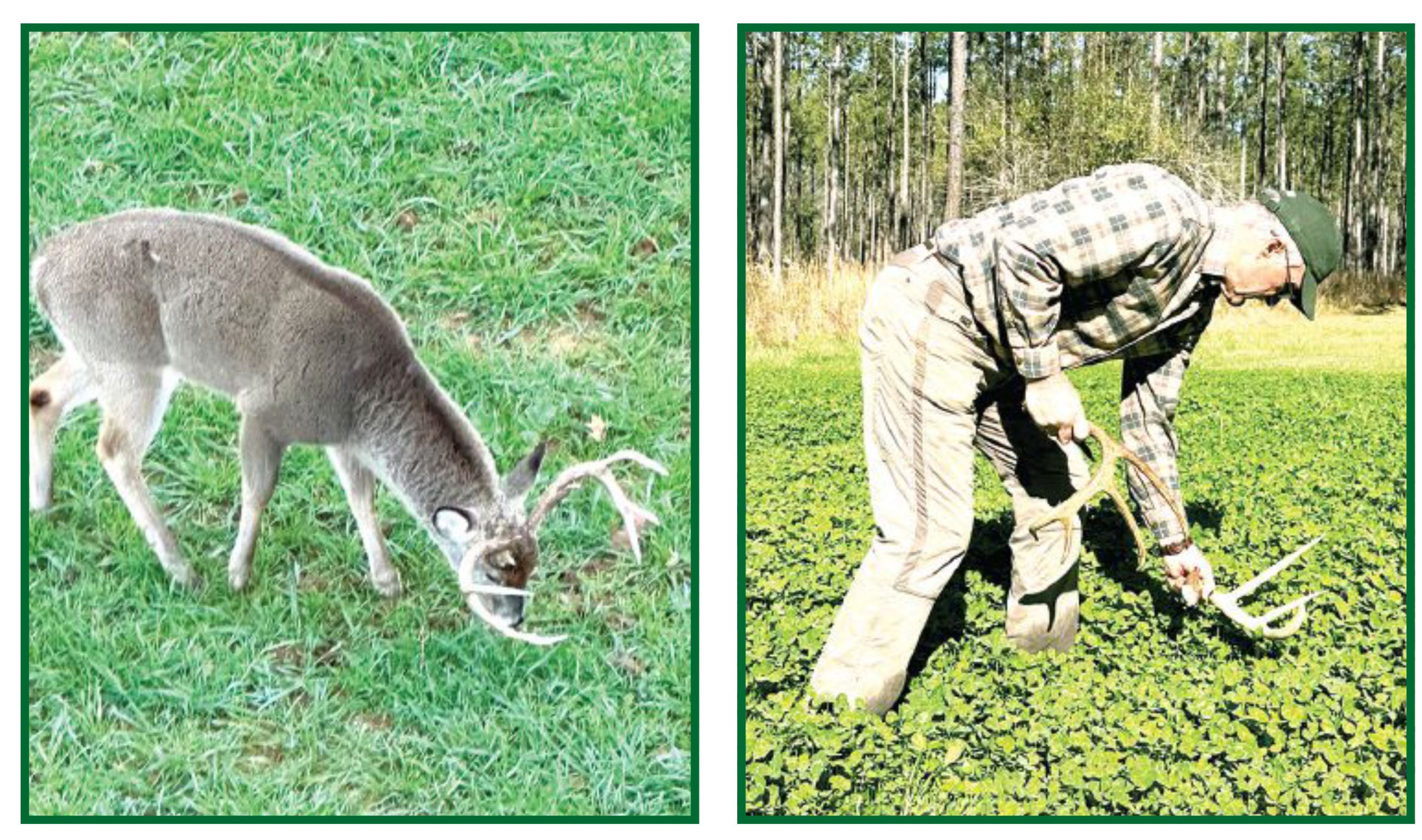
Most hunters start to hang it up when they are missing out on the most important time of year for whitetail hunt-ers to have a successful season the next fall. This may include constructing new hunting stands, establishing new food plots, incorporating proper deer nutrition and placing feeders in new locations. Spring is a pivotal time for wildlife, making it the ideal moment to under-take important tasks such as performing control burns, planting trees that yield beneficial mast or fruits and managing food plots for optimal growth. The early spring months are also when bucks start to regrow their antlers – which, let’s face it, is one of the things we are all after.
Although winters in North Florida and South Georgia are generally mild, they can still impact your deer herd and other wildlife. Limited food sourc-es during this time can be particularly challenging as bucks recover from the rut and does enter early pregnancy.
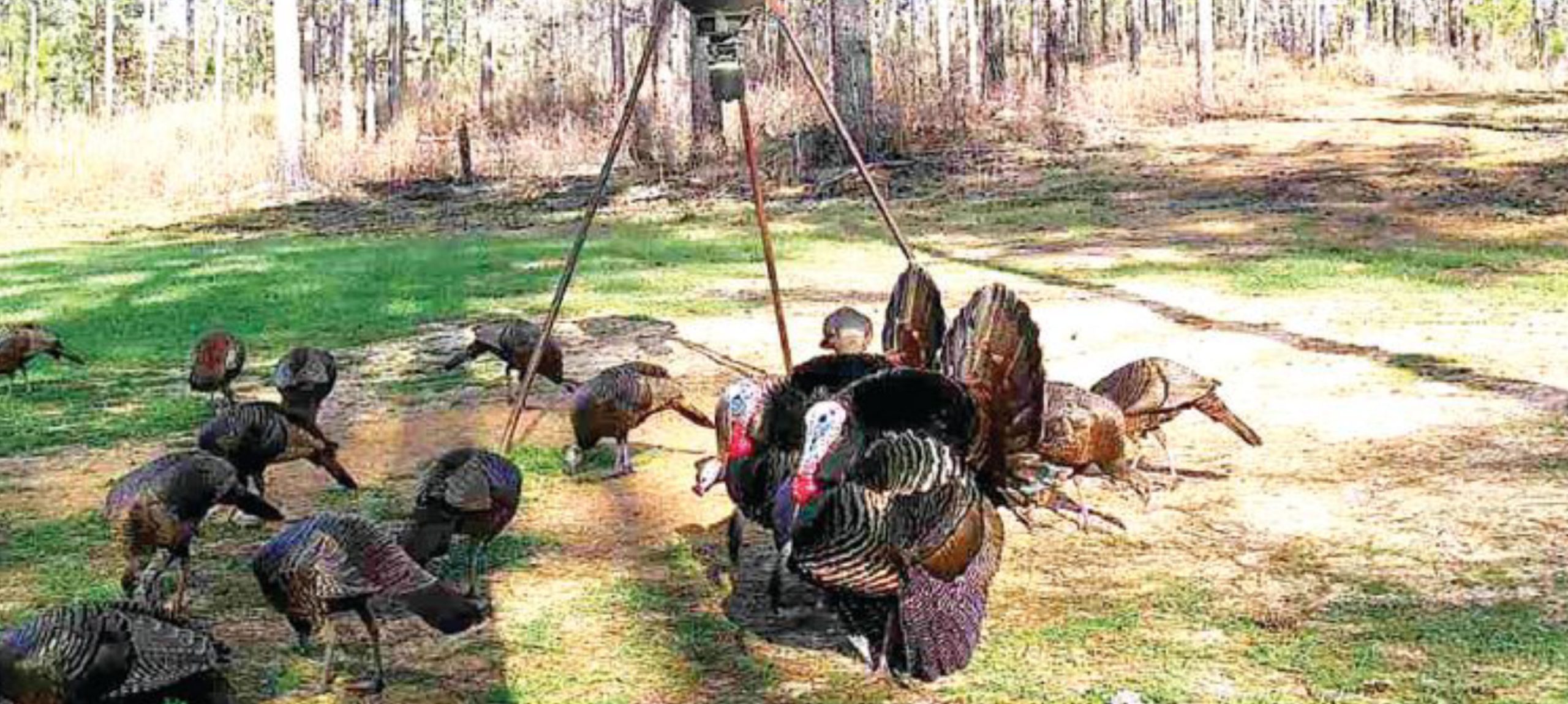
This is where highly-nutritional food plots and supplement feeding play a critical role in the health of your herd or flock. Likewise, turkeys and quail require extra nutrition during this crucial time, as their nesting season is approaching to assist in increasing egg production, which leads to successful poult production. We like to spread or run Milo in feeders this time of year for turkeys and quail.
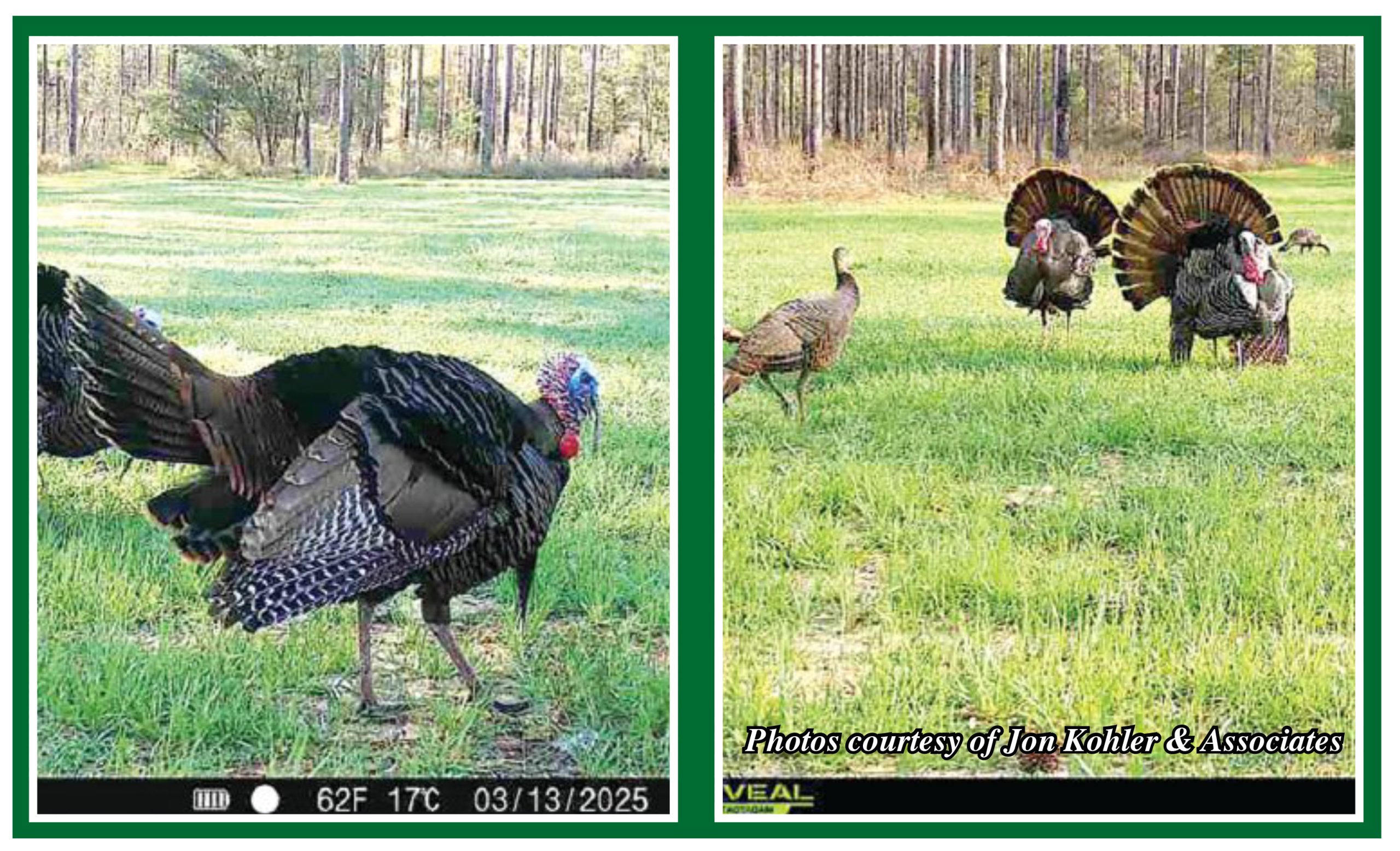
Supplemental protein feeding for deer has gained popularity, and feeding for turkeys can be beneficial as well, but a high-quality, high-protein, well-main-tained food plot is essential. Deer pri-marily browse on leaves, twigs and succulent new growth (especially after a control burn) rather than native-type grasses, making food plots particular-ly important during the late winter and early spring if they are properly main-tained. Turkeys also utilize clover plots intensively during the spring. We have harvested gobblers during the spring, and their craws would be packed with clover leaves.
Heading into the fall planting sea-son, aim to have food plots ready to plant and fertilize by mid-September, whether they are going to be new plots or estab-lished plots where you may no-till addi-tional forage for the fall. We typically try to plant in the area of North Florida and South Georgia in the first week of October, depending on moisture and keeping a close eye on the weather forecast to plant before a rain or after, which helps ensure a good stand.
A preferred mixture includes for-age, oats and wheat, along with a clover and chicory blend – recommending put-ting at least 15 pounds per acre of a chic-ory/clover blend. Chicory is a favorite and is high in protein and tends to thrive in lighter or heavier soils, while clovers tend to do better in heavier soils. Chico-ry is particularly resilient, drought-toler-ant and can withstand heavy browsing, making it an excellent perennial choice.
If a property has the plot space, plant a straight clover field at 50 pounds per acre or a chicory field of approxi-mately 20 pounds per acre. The straight clover fields or chicory fields have a high initial cost but can thrive for years with the proper care, so in the long run, they can pay dividends. These fields have the added benefit of being shed magnets because of the amount of time bucks spend on them as they are trying to recover from the rut.
Unfortunately, many people plant food plots in the fall, fertilize them once, and then neglect them for the remainder of the hunting season. We constantly monitor food plots for color (dark green) and new growth to indicate when addi-tional fertilizer is needed.
For new plots, we recommend taking soil samples to check pH levels and determine if lime is needed. Preparing the soil for a smooth seedbed using a rotovator or field cultivator is vital, es-pecially for smaller seeds like clover, chicory and alfalfa, using a cultipacker to assist in firming the seedbed so when the small seeds sprout, they have excel-lent soil contact with the root system.
 You could consider dividing your plots into halves or thirds to plant var-ious perennial varieties, such as maybe straight clover or chicory, leaving out the wheat and oats, or planting annuals, such as Sunn Hemp blended with Lablab, for-age-type peas or soybeans, that produce excellent tonnage and peak at various times of the year, ensuring a continuous supply of nutritious forage. We have even no-till planted round-up ready corn and round-up ready forage soybeans in a mixture of five pounds of corn seed per fifty-pound bag of soybeans. This mixture was a little more costly, but was very productive.
Key challenges for food plots in our area include dry weather, heat, humidity, weed control and over-brows-ing. Regarding over-browsing, this is a reason we like chicory to withstand over-browsing, particularly in drought conditions, due to its substantial taproot. are becoming tough and less palat-able to deer. This is the time to spray a grass-specific herbicide on the plot to kill the grasses and release the clover and chicory. For grass control, we like to use Clethodim, which is an active ingre-dient in several generic grass herbicides. Without the competition from the grasses, the clover in particular really starts to shine at a time that the deer herd needs it the most.
You can also incorporate addi-tional annual crops, such as cowpeas, using a no-till method, and Joint Vetch – Aeschynomene, to assist in supple-menting chicory during the late spring/summer. But when you receive good rainfall, we recommend fertilizing chic-ory with a high nitrogen fertilizer to promote lush growth and possibly mow-ing to the height of six to eight inches to control unwanted weeds and promote new growth during late summer.
We also like to use split applica-tions of fertilizer at planting and every eight to 12 weeks throughout the grow-ing season to ensure high nutritional val-ue and palatability in the plots, keeping them highly attractive for deer feeding. These are two guiding principles: the harder you work, the luckier you be-come; and you reap what you sow.
These principles apply to wildlife management as well. Friends and clients who find consistent success are those who work hard and go the extra mile in managing their properties.
Regardless of how you’re set up to plant and manage your property, it’s a year-round commitment. If you’re not dedicating the time, chances are your neighbor is.
 From murky farm ponds to pristine glacier-cut lakes and everything in between, Knox Daniels’ expertise stems from a lifelong fascination of water and the creatures that live in and around it. He recognizes and helps clients appreciate the value water features bring to a property. “My goal is to help buyers realize and sellers maximize the value different water bodies bring to a property, not only in a recreational sense, but also for social storm reasons.” After extensively traveling the country for collegiate BASS fishing tournaments, Knox graduated and worked for the Southeast’s finest fisheries and wildlife biologist, Greg Grimes. With Grimes’ company, AES, Knox managed many of the southeast’s finest private lake estate/impoundment properties, and learned the intricacies of upscale property management. Learning from Greg and other biologists, Knox honed in on the specific conditions and habitat needed for optimal gamefish growth in private lakes. He has also worked as a property manager on several thousand acres and for a commercial developer, facilitating the dirt work and builds of several apartment complexes, but his true passion has always been in the outdoors. “I’ve always had an insatiable fascination with ponds/lakes and am grateful to be able to help to place clients on the properties of their dreams and make their personal fisheries/wildlife goals reality with JKA.” – Knox Daniels
 Jason has been assisting landowners for the last 28 years in Georgia and South Carolina obtain achievements the owners did not realize were possible. His degree in Biology from Georgia Southern stemmed from the desire to know how things in nature work. His plantation roots began at just 16 years old outside of Albany, GA and the last 20 years were spent in the Lowcountry of South Carolina. His entire career has been spent developing a global approach to plantation management. That plan included sales. Sales is in Jason’s blood- his mom had a 45-year career as a real estate broker. After college, he chose to pursue his passion of making properties great. In 2011, Jason sold his first plantation. Since then, he has assisted buyers and sellers with over $20 million in sales while most of that time working as a full-time General Manager of a large Lowcountry plantation. Today, he is committed to using his unique skill set and experience to guide landowners through the many challenges of plantation ownership.
 Bruce Ratliff is a retired elected official (Property Appraiser Taylor County). Bruce brings years of experience in ad valorem tax knowledge. His property tax background gives JKA Associates & clients a unique insight into the complicated tax process. Bruce held several positions in the Florida Association of Property Appraisers, including member of the Board of Directors, President, Vice-President and Secretary, and served on the Agricultural & Legislative Committees for the Association. The real estate business has been part of Bruce’s life since childhood. His mother, Shirley Ratliff owned Professional Realty of Perry, Florida and his father, Buster owned Ratliff Land Surveying which Bruce was General Manager of before his political career.
 Hailing from a long line of outdoorsmen, Tim learned a great deal from his father and grandfather. He saw first-hand what it means to be a good land steward. He believes land is so much more than a place to hunt, fish, and grow timber or crops. “It’s an identity, a resting place, a safe haven and a way of life, said Tim.” Tim’s family ties to Alabama run deep. During his grandfather’s first term, Governor James was responsible for signing into law Alabama’s first state duck stamp which helped to ensure funding for the procurement, development, and preservation of wetlands for migratory waterfowl habitat. He also established Alabama’s lifetime hunting license, so it is no surprise that Tim is an avid outdoorsman with a keen eye as to how best to improve habitat for the greater good of its wildlife.
 With Madison County roots, Lori grew up on her family farm at Pettis Springs along the historic Aucilla River. A love of the land was instilled in Lori very early on by her father who was a local farmer. Lori understands the importance of good land stewardship and has witnessed first-hand how her own father, a former 2-term member of the Florida House of Representatives whose district encompassed many rural counties of the Red Hills Plantation Region, with a little bit of sweat equity, so lovingly worked their own family land. These are core values she carries with her today, and nothing gives her more personal satisfaction than to represent some of the south’s best land stewards.
 Cole’s dedication to land management lies in his family roots. As a fourth-generation timber expert, Cole’s earliest memories were spent with his father managing timber investments. With a degree in Food Resource Economics from the University of Florida, Cole is the epitome of an up-and-coming leader. He grew up with a hands-on approach to learning land management and conservation and has spent the last 15 years learning every angle of the real estate and forest industry. Cole is a member of the Florida Forestry Association, Red Hills Quail Forever, Southeastern Wood Producers Association and he uses this platform as an advocate for landowners and their land investments. His family has dedicated the past 60 years to providing landowners in North Florida and South Georgia with professional land management services focused on improving and protecting one’s forestland and wildlife investment. In fact, their family business, M.A. Rigoni, Inc., was one of the first to introduce whole tree chipping to the Red Hills Region.
 As a landowner of his own family farm, Lick Skillet, along with family land that has been passed down and enjoyed together at Keaton Beach for 40 years, Jon knows what it means to be a steward of the last best places. As a third-generation land broker with more than 30 years of experience in advising landowners in this niche, Jon is known for his innate ability to harvest a land’s unique intrinsic value. Touting several notable sales under his belt, Jon personally closed Rock Creek/Molpus – 124,000 acres of premium timberland at $142,000,000 – which was known as the largest timberland land sale in the Southeast for eight years running. He is a co-founding member of LandLeader and achieved the real estate industry’s highest honor, “2022 National Broker of the Year – Recreational Land Sales,” by the Realtors® Land Institute.