
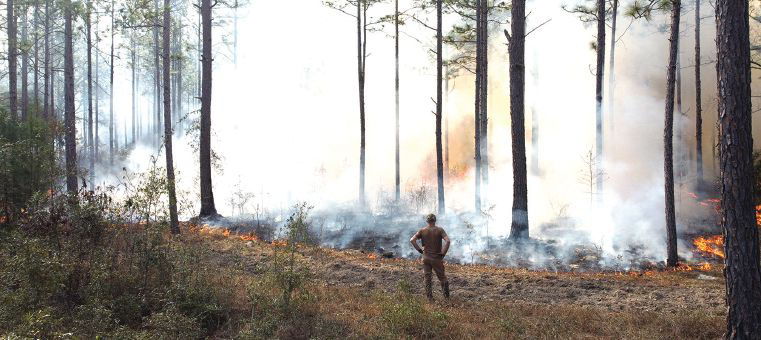
by Kristen Traugh Courtesy of SW GA Farm Credit
There’s a story from our region that’s often told around campfires, in dusty side-by-sides and during prescribed burning certification classes around us.
It goes like this: Once upon a time, in the land of Florida, there lived a landowner who burned his property. He did this to keep his woodlands healthy, but all his neighbors thought he was just a little crazy. One day, a massive wildfire approached the town, leaving a path of destruction. The fire reached the man’s property and fizzled out. The very grateful neighbors celebrated him and renamed the town after him.
While a little cliche, this story highlights one of the main benefits of prescribed burning in our local fire ecology. A controlled and regulated fire can prevent a more dangerous wildfire. But many people are surprised to learn of some more little-known benefits.
Take ticks, for instance. Lyme disease has increased more than 100% in the past 10 years, not to mention Heartland Disease, Rocky Mountain Spotted Fever and AGS, the red meat allergy. Large populations of deer and wild hogs also act as hosts for ticks.
Studies show that unburned forests can have up to 10 times the number of ticks of burned areas. Of course, fire will kill ticks, redbugs and other pests in the short term. More importantly, though, fire changes the tick’s environment, destroying the woody brush they climb on and allowing for more wildlife that are not so hospitable to them.
Jon Kohler, the founder of Jon Kohler & Associates, a realty firm specializing in high-quality land, knows this firsthand.
“Growing up, fire was not a part of my parents’ culture,” he said. “They were from up North. But it was part of the local culture. I remember many old timers who were very proficient at burning. These were some of my earliest memories.”
In any conversation about land stewardship, Jon is quick to point out that fire is just as natural as water. During pre-Columbus times, natural fires swept from river system to river system before wagon trails became firebreaks. But times were changing.
“During the 1940s,” Jon notes, “this group called the Dixie Crusaders came around. They were showing a movie when most people had never seen one before, so it was a big deal. They were telling people they needed to stop burning. People rejected that notion here while other areas of the country embraced it wholeheartedly.”
Ryan Simpson of Simpson Forestry in Southwest Georgia is one of those advocating for the proper use of fires.
“Fire is just a vital key to good land management,” Ryan said. “This is what we do to maintain property and qualify as a good steward of the land. It’s crucial here. Without it, our quail plantations would not be what they are, and our timber tracts would not be what they are either.”
Aside from mitigating wildfire risk and preventing ticks, these burns improve the aesthetics of our region by reducing understory mass to allow for plants to flower, creating a better environment for pollinators. Diseases like fusiform rust and harmful pine cone insects like the white pine cone beetle can be controlled by fire. Burning is used to prevent weeds while pine stands are established and can even promote growth when the pines hit the rocket stage.
Brant Harrell, a relationship manager at Southwest Georgia Farm Credit, has another take on prescribed burns.
“It really opens up everything and allows you to take inventory and manage your timber,” Brant said. “On my place, we identify hardwoods that may be isolated. ” We cultivate them, trim them up, and use some herbicide to allow them to produce acorns,” he says.
In a habitat where deer graze frequently, some food sources can soon be out of reach for them without fire to restore ground-level growth. It also provides more open spaces for gamebirds, rabbits, songbirds and insects. Even pyrophilous fungi species, like the Pyrone-ma, flourish after a fire as they consume dead soil organisms and sometimes charcoal itself.
Even on a cellular level, fire is beneficial. Most people associate trees with the sequestration of carbon, cleaning the air and lowering greenhouse gases. In reality, the roots of grasses are more effective than trees at this, and we can create the ideal environment through fire.
Even farmers and ranchers use fire to clear out dead material with low nutrients to make way for higher-value graz-ing for their livestock, and in the process reduce noxious weeds.
Just as important though, are the economic benefits of prescribed burning. Burning creates space for more efficient cruising and harvesting of timber and develops areas for hunting.
“I’d say that 50% of my burns are wildlife-driven due to the amount of recreation we have locally,” Ryan said. “It’s really the cheapest tool landowners have to maintain their property.”
The value to the land increases over the years. Jon mentioned an example of two very similar properties with the main difference being that one was regularly burned while the other was not. The burned property was valued at $1,200 more an acre than the other.
Jon continued, “These properties are like owning a mini-state or national park and are usually managed better than such.”
Oftentimes, we see situations where the family patriarch passes away and with him, the practice of prescribed burning. Landowners can get out of the habit of burning.
“It’s like having a pool,” Jon says. “You pay for pool maintenance even if you don’t swim. If you choose not to maintain it, every dollar you save there, you’ll have to spend it back on repairs.”
What time of the year a prescribed burn happens determines the effects on the land. Summertime burns are necessary to promote seed fall in longleaf stands and for natural wiregrass production. An early fall burn before the frost improves forest health while removing debris. Burns during the winter are used to destroy heavy fuel loads, producing more oak sprouts and fewer wildflowers. Most common, though, are springtime burns, which help grasses flower, improve legumes and limit hardwood competition.
“The cold fronts and north winds of spring are your friends,” Jon said. “It’s a lot better than dealing with the unpredictable winds later in the year.”
Georgians implement prescribed burns on 1.4 million acres every year. Therefore, there are many resources for help available.
“We have great support from our local forestry commission offices, and we get a lot of referrals from them,” Ryan says.
The Georgia Forestry Commission (GFC) can help create burn plans, which include goals, land topography, neighboring landowners and, of course, a burn permit. They offer equipment loans for a fee and can help with preparation. The GFC can be on hand during the burn, as long as the landowner is the one who starts the fire. They offer online resources, as well fire weather predictions and formulas to calculate the efficiency of the burn. As an added service, prescribed fire manager certifications are available upon completion of the classes.
Additionally, Tall Timbers is a research and conservation database that supports our natural fire ecology. They, along with the NRCS, developed three prescribed burn associations for Central Alabama, Northwest Florida, and Southwest Georgia, respectively.
“Fire is just a vital key to good land management. This is what we do to maintain property and qualify as a good steward of the land. It’s crucial here,” Ryan said.
Even with such assistance, prescribed burning doesn’t come without complaints.
“There are burn bans driven by population growth. This is done when an area becomes metropolitan. Even Macon has one,” Ryan says.
“People always talk about the smoke plumes from burning. It’s inconvenient,” says Jon. “But our backfiring fires have a high burn rate and there are fewer smoke particles in the air than from a wildfire burning inefficiently.”
Some even suggest that prescribed fires should be a shared cost as a community service. Typically, landowners shoulder all the risk and cost, but the practice can benefit and protect everyone surrounding the property.
“Everything will burn, it’s just a matter of time,” Jon says.
But for those involved in burning, it’s an enjoyable time to reconnect with the land.
“In my work as a land consultant, I get to see many people who take pride in their places,” Ryan said. “I have a lot of hands-on customers. There are a lot of what we call generational farms and these owners are very contentious about their kids taking their kids to these properties. I work with one absentee landowner in Sumter County, and we try to schedule burns for his son to be a part of. He went from riding on the Polaris and just watching us to driving himself and checking fire lines. Now, we put him on water duty!”
Out on Jon Kohler’s personal property called Lick Skillet, he puts himself in what he calls “the six-month burn club.”
“My boys get upset if we burn on a school day,” he said.
It’s a similar scene on Brant Harrell’s land too.
“It’s a big ordeal for the weekend. There’s a lot that goes into burning to get everything prepared. It’s family time for
- I get together with some buddies and we help each other out with burning. It’s really a social event here,” he said.
Even with all the positive results of prescribed burning, there’s one more.
“This is something you can see instant results with,” says Ryan. “This is gratification in my profession. And you can see it instantly.”
There is a lot of support in the state of Georgia for prescribed burns in our grasslands and forests. Between programs and mentors, wildlife aficionados and people interested in the local culture, this is one fire that won’t be dying out soon.
 From murky farm ponds to pristine glacier-cut lakes and everything in between, Knox Daniels’ expertise stems from a lifelong fascination of water and the creatures that live in and around it. He recognizes and helps clients appreciate the value water features bring to a property. “My goal is to help buyers realize and sellers maximize the value different water bodies bring to a property, not only in a recreational sense, but also for social storm reasons.” After extensively traveling the country for collegiate BASS fishing tournaments, Knox graduated and worked for the Southeast’s finest fisheries and wildlife biologist, Greg Grimes. With Grimes’ company, AES, Knox managed many of the southeast’s finest private lake estate/impoundment properties, and learned the intricacies of upscale property management. Learning from Greg and other biologists, Knox honed in on the specific conditions and habitat needed for optimal gamefish growth in private lakes. He has also worked as a property manager on several thousand acres and for a commercial developer, facilitating the dirt work and builds of several apartment complexes, but his true passion has always been in the outdoors. “I’ve always had an insatiable fascination with ponds/lakes and am grateful to be able to help to place clients on the properties of their dreams and make their personal fisheries/wildlife goals reality with JKA.” – Knox Daniels
 Jason has been assisting landowners for the last 28 years in Georgia and South Carolina obtain achievements the owners did not realize were possible. His degree in Biology from Georgia Southern stemmed from the desire to know how things in nature work. His plantation roots began at just 16 years old outside of Albany, GA and the last 20 years were spent in the Lowcountry of South Carolina. His entire career has been spent developing a global approach to plantation management. That plan included sales. Sales is in Jason’s blood- his mom had a 45-year career as a real estate broker. After college, he chose to pursue his passion of making properties great. In 2011, Jason sold his first plantation. Since then, he has assisted buyers and sellers with over $20 million in sales while most of that time working as a full-time General Manager of a large Lowcountry plantation. Today, he is committed to using his unique skill set and experience to guide landowners through the many challenges of plantation ownership.
 Bruce Ratliff is a retired elected official (Property Appraiser Taylor County). Bruce brings years of experience in ad valorem tax knowledge. His property tax background gives JKA Associates & clients a unique insight into the complicated tax process. Bruce held several positions in the Florida Association of Property Appraisers, including member of the Board of Directors, President, Vice-President and Secretary, and served on the Agricultural & Legislative Committees for the Association. The real estate business has been part of Bruce’s life since childhood. His mother, Shirley Ratliff owned Professional Realty of Perry, Florida and his father, Buster owned Ratliff Land Surveying which Bruce was General Manager of before his political career.
 Hailing from a long line of outdoorsmen, Tim learned a great deal from his father and grandfather. He saw first-hand what it means to be a good land steward. He believes land is so much more than a place to hunt, fish, and grow timber or crops. “It’s an identity, a resting place, a safe haven and a way of life, said Tim.” Tim’s family ties to Alabama run deep. During his grandfather’s first term, Governor James was responsible for signing into law Alabama’s first state duck stamp which helped to ensure funding for the procurement, development, and preservation of wetlands for migratory waterfowl habitat. He also established Alabama’s lifetime hunting license, so it is no surprise that Tim is an avid outdoorsman with a keen eye as to how best to improve habitat for the greater good of its wildlife.
 With Madison County roots, Lori grew up on her family farm at Pettis Springs along the historic Aucilla River. A love of the land was instilled in Lori very early on by her father who was a local farmer. Lori understands the importance of good land stewardship and has witnessed first-hand how her own father, a former 2-term member of the Florida House of Representatives whose district encompassed many rural counties of the Red Hills Plantation Region, with a little bit of sweat equity, so lovingly worked their own family land. These are core values she carries with her today, and nothing gives her more personal satisfaction than to represent some of the south’s best land stewards.
 Cole’s dedication to land management lies in his family roots. As a fourth-generation timber expert, Cole’s earliest memories were spent with his father managing timber investments. With a degree in Food Resource Economics from the University of Florida, Cole is the epitome of an up-and-coming leader. He grew up with a hands-on approach to learning land management and conservation and has spent the last 15 years learning every angle of the real estate and forest industry. Cole is a member of the Florida Forestry Association, Red Hills Quail Forever, Southeastern Wood Producers Association and he uses this platform as an advocate for landowners and their land investments. His family has dedicated the past 60 years to providing landowners in North Florida and South Georgia with professional land management services focused on improving and protecting one’s forestland and wildlife investment. In fact, their family business, M.A. Rigoni, Inc., was one of the first to introduce whole tree chipping to the Red Hills Region.
 As a landowner of his own family farm, Lick Skillet, along with family land that has been passed down and enjoyed together at Keaton Beach for 40 years, Jon knows what it means to be a steward of the last best places. As a third-generation land broker with more than 30 years of experience in advising landowners in this niche, Jon is known for his innate ability to harvest a land’s unique intrinsic value. Touting several notable sales under his belt, Jon personally closed Rock Creek/Molpus – 124,000 acres of premium timberland at $142,000,000 – which was known as the largest timberland land sale in the Southeast for eight years running. He is a co-founding member of LandLeader and achieved the real estate industry’s highest honor, “2022 National Broker of the Year – Recreational Land Sales,” by the Realtors® Land Institute.