
Rockhill
Randolph County, Georgia⁞377± ACRES
A Sporting Property Years in the Making
- 377± acres high-quality recreational property in Randolph County, GA
- Custom-built Home 2,260 sq ft, 2 BR/4 BA built in 2024
- Custom heart pine furniture
- Backup generator
- Approximately 5-acre, clear, spring-fed and stocked pond with exceptional clear water
- Four separate natural spring heads throughout the property
- Equipment Barn
- Exceptional whitetail habitat with mature white oak bottoms
- History of quality bucks in the 150–160-inch class
- Abundant wild turkey population
- Exceptional wild quail habitat and population
- Hundreds of planted sawtooth oaks and fruit trees
- Approx 216± acres of young planted loblolly pine
- Approx 106± acres of hardwoods, including mature white oak bottoms
- Diverse mix of planted pine, hardwoods, water and transitional wildlife habitat
- Original wagon trail road running through the property
- Old wells associated with a former trading post
- Years of established wildlife and land management already in place
- Equipment available for purchase
- Approx 15 minutes to restaurants in Cuthbert, GA
- Located just 45 minutes to Eufaula, AL and 50 minutes to Albany, GA
Few Properties This Size Offer This Much Wildlife, Water & Recreation
Trophy Whitetail, Wild Quail, Great Turkey, and Natural Water
Exceptional Sporting Properties Don't Happen by Accident.
Rockhill is a 377± acre recreational and sporting property in Randolph County, Georgia, where years of deliberate wildlife and land management have created something increasingly difficult to replicate.
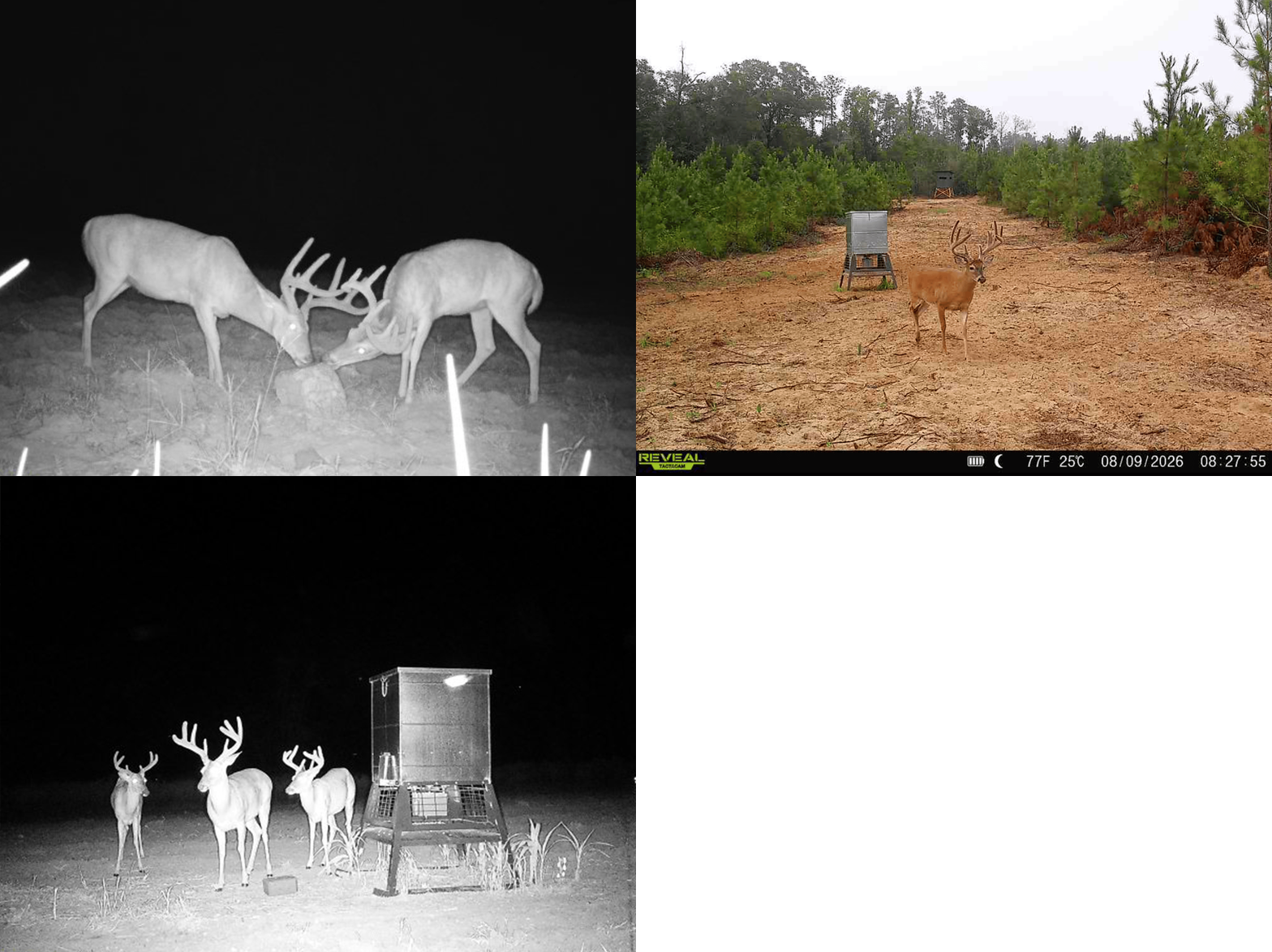 A remarkably clear, spring-fed pond, four natural spring heads, mature hardwood bottoms, hundreds of planted mast and fruit trees, young pine habitat and an established wildlife program come together with a custom home, barn and improvements to create a property that is ready to enjoy from day one.
But what distinguishes Rockhill is not any one of those features. It is what five years of patient, disciplined management have created across the property.
The current owner, Jeff Karter, approached Rockhill with a philosophy that reaches well beyond hunting. His goal was to improve the land itself and leave something better behind.
“I wanted to make it better—the land, how it looked, the preservation of it and the history of it. I wanted to leave it better than I got it.”— Jeff Karter, Owner
That philosophy is evident throughout Rockhill—from the wildlife habitat and timber management to the preservation of historic features and improvements designed to complement the land.
An Exceptional Turkey & Wild Quail Property
Rockhill's habitat diversity has produced equally impressive results for turkey and wild quail.
Multiple groups of wild turkeys regularly utilize the property, and the spring-fed pond has become a natural gathering point.
“You can hunt four to six groups of turkeys in any given day. One morning, my wife and I counted over 60 hens and gobblers around the pond and in the trees.” — Jeff Karter
Rockhill is also noteworthy for something increasingly difficult to find in the Southeast: a naturally occurring wild quail population.
According to Karter, a Georgia state wildlife biologist visited the property and documented an extraordinary concentration of wild birds.
“The state biologist came out here and counted 13 separate wild quail sitting right here. He told me, ‘You have more quail on this little piece of property than I’ve seen in three counties combined.’” — Jeff Karter
The combination of young pine, mature hardwoods, edge habitat, open areas, natural water and active land management has created a property capable of supporting multiple sporting uses rather than being managed around a single species.
Water You Can See Coming Out of the Ground
One of Rockhill's defining natural features is its approximately 5-acre stocked, spring-fed pond.
The water is exceptionally clear, with spring water visibly emerging from the ground—immediately distinguishing it from a typical constructed farm pond. Four additional natural spring heads are located throughout the property, weaving dependable natural water into the wildlife habitat.
“The water’s really clean because it never stops flowing…there’s no algae in the pond at all. It’s a little sanctuary as well.” — Jeff Karter
The pond is more than another amenity. It is a gathering place for wildlife, a recreational resource and one of the natural features that gives Rockhill its character.
A Turnkey Sporting Retreat Built for Gathering
At the heart of Rockhill is a custom-built home designed around how a sporting property is actually used.
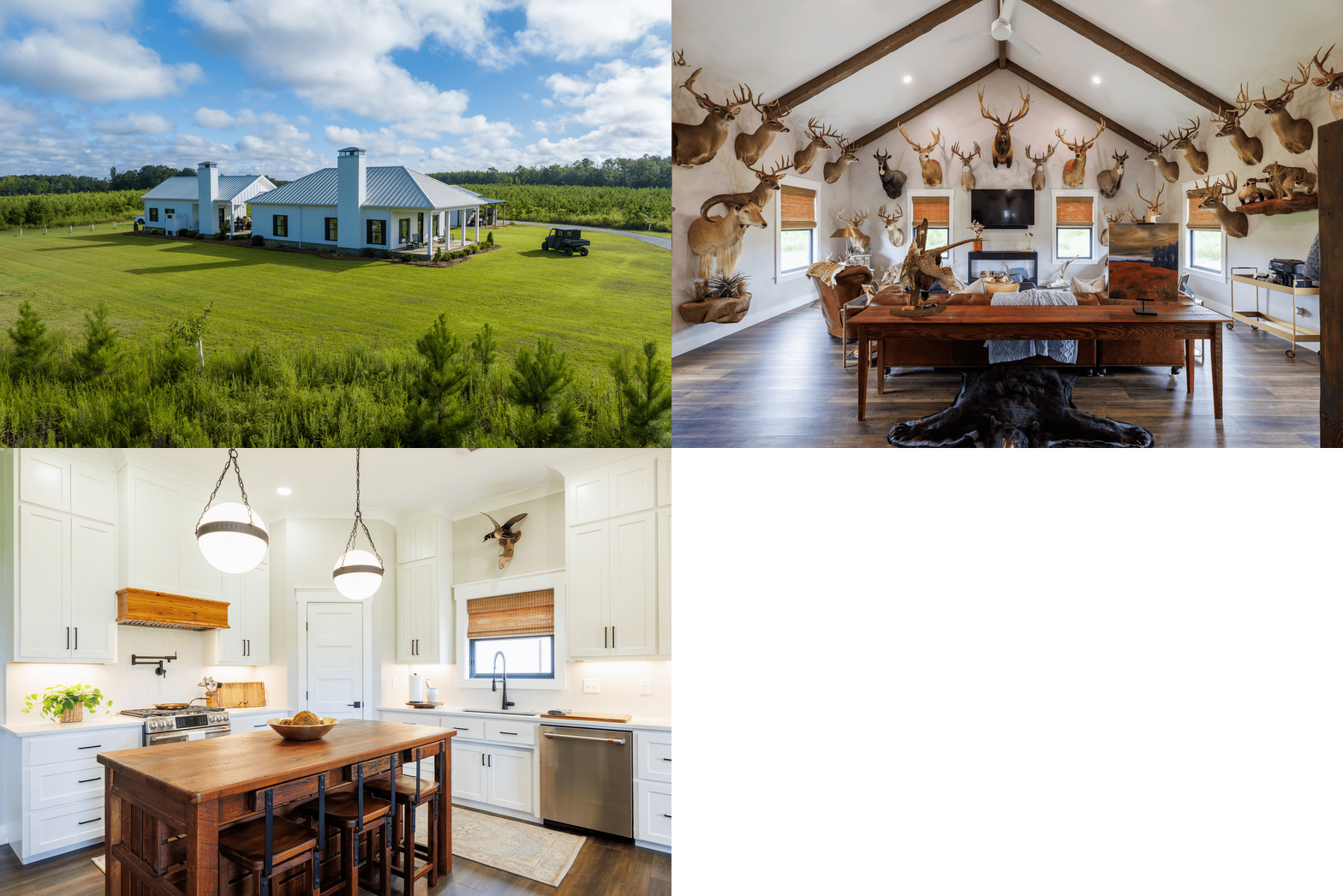 The approximately 2,260-square-foot home was completed in 2024 and features two bedrooms and four baths, with primary and guest bedrooms in nearly identical size/design. It is a SWGA shotgun plan you can see through, front door to back, with custom cabinetry throughout so no space is wasted. The furniture was built by one craftsman — a man who furnished the plantations around South Georgia and has since passed — out of heart pine pulled from old barns, some late 1800s, some early 1900s. A few pieces were cut from beams hewn with an ax rather than sawn, one beam sectioned so the legs matched. You rarely find that wood now, and you rarely find people who can build like that.
“The concept of this house was to be a meeting area and a gathering point.”
Karter wanted the architecture and interiors to feel appropriate to the property and to the sporting traditions of the region.
“I wanted it to be very warm and inviting and very comfortable, but I also wanted it to have that mini-plantation feel.” — Jeff Karter
The barn was the first thing built — spray-foamed so it stays cool and tight against rodents, pallet racking, deep freezer, side-by-sides. A second pole barn on the back of the property holds the dozer, excavator, track loader, tractor implements and corn wagon. The equipment is available for purchase separately — everything he used to make this place what it is, if you want it.
The bunkhouse may tell the story of Rockhill better than any other improvement.
Jeff modeled it after his grandfather's 1920s-era cracker house, where a back room was lined with single beds. As a boy, Jeff would stay there, spend his days chasing dogs with his grandfather and his nights listening to story after story from the old man. It was there that his own love of deer hunting and the outdoors took root.
Years later, Jeff built a version of that bunkhouse at Rockhill for his own children—a place for the next generation to gather, stay up late and share their own stories.
It is a small detail, but it says a great deal about why Rockhill was built the way it was. This was never intended to be simply a hunting property. It was built as a place to be shared.
For the next owner, that matters. The expensive and time-consuming work of establishing the residence, infrastructure, habitat and wildlife program has already been done. But so has something harder to create: Rockhill already feels like a place where traditions can take root.
The next owner can enjoy it immediately while continuing the stewardship—and creating the next chapter of stories—already underway.
377 Acres That Benefits From a Much Larger Landscape
One of Rockhill's less obvious advantages extends beyond its boundaries.
The property benefits from neighboring landowners who share compatible wildlife-management philosophies, creating a substantially larger surrounding landscape with relatively low hunting pressure and complementary management.
For a sporting-property buyer, that surrounding ownership matters.
Wildlife does not recognize property lines. The quality of neighboring habitat, hunting pressure and management can be every bit as important as what occurs within the property's own boundaries.
Rockhill benefits from an unusually favorable neighborhood in that regard.
A Timber Component With a Purpose
Approximately 216± acres are planted in young loblolly pine, including approximately 134± acres of three-year-old loblolly on the southern portion of the property and approximately 82± acres of young loblolly on the northern portion.
Another approximately 106± acres are in hardwoods, including substantial mature hardwood bottoms.
The timber represents a future land-value component, but its importance to Rockhill today goes well beyond timber value.
The varying ages and types create bedding areas, transition zones, travel corridors, security cover and edge habitat alongside the property's mature hardwoods and natural water resources.
The result is a timber plan that contributes directly to the property's sporting value today while retaining a future economic component.
A Connection to the Land's Past
An original wagon-trail road still winds through Rockhill, while old wells reportedly associated with a former trading post offer a glimpse into the property's history.
Those remnants are subtle, but they matter—particularly on a property whose owner has intentionally tried to preserve what came before while improving what he could.
That brings the story back to Karter's original objective: “I wanted to leave it better than I got it.”
Location
Located near Coleman in Randolph County, Georgia, Rockhill offers genuine privacy and seclusion while remaining convenient to Southwest Georgia and North Florida.
The property is approximately 10–15 minutes from Cuthbert for restaurants and groceries, approximately 45 minutes from Lake Eufaula, 50 minutes from Albany, 1.5 hours from Thomasville and approximately two hours from Tallahassee.
Southwest Georgia Regional Airport in Albany provides commercial air service approximately one hour away, while Randolph County Airport in Cuthbert provides private aviation access approximately 20 minutes from the property.
This accessibility makes Rockhill well positioned as a private sporting retreat that can be enjoyed for a weekend or an extended stay without sacrificing the seclusion that defines it.
A Property That Would Take Years to Recreate
The real value of Rockhill is not found in any single improvement, wildlife statistic or acreage category.
It is in what they have become together.
The spring water was here. The hardwood bottoms were here. But developing the property into what it is today required vision, investment, patience and time.
The home and infrastructure can be assigned a value. So can the timber. But an established wildlife program, years of habitat improvement, mature age structure, favorable neighboring management and five years of restraint cannot simply be purchased and installed after closing.
That is what makes Rockhill different.
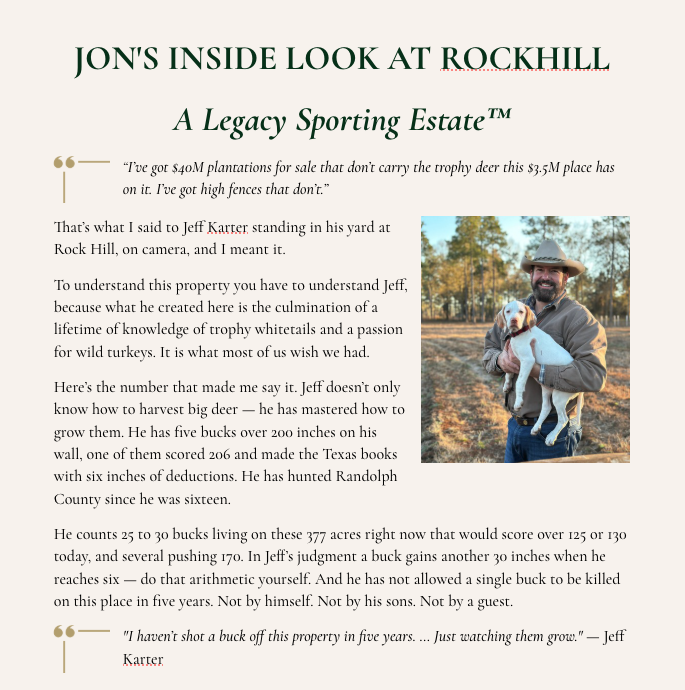
After walking Rockhill, studying its wildlife program and spending time with the owner, Jon Kohler shares what makes this property different — and why some of its most valuable attributes aren't obvious from an acreage map or improvements list. → Read Jon's Inside Look →
For someone looking for a turnkey Georgia sporting property with quality improvements, extraordinary natural water and a wildlife program already years ahead of where most properties begin, Rockhill offers something increasingly difficult to find:
The opportunity to begin enjoying on day one what took someone else years to create.
Broker’s Comments
The Kohler & Associates’
Difference
Didn’t find what you were looking for? Or want to discuss the market with the Leader in this niche?
Contact us to discuss one of our properties, for information on properties that are not yet released to the market or to discuss the market.
 From murky farm ponds to pristine glacier-cut lakes and everything in between, Knox Daniels’ expertise stems from a lifelong fascination of water and the creatures that live in and around it. He recognizes and helps clients appreciate the value water features bring to a property. “My goal is to help buyers realize and sellers maximize the value different water bodies bring to a property, not only in a recreational sense, but also for social storm reasons.” After extensively traveling the country for collegiate BASS fishing tournaments, Knox graduated and worked for the Southeast’s finest fisheries and wildlife biologist, Greg Grimes. With Grimes’ company, AES, Knox managed many of the southeast’s finest private lake estate/impoundment properties, and learned the intricacies of upscale property management. Learning from Greg and other biologists, Knox honed in on the specific conditions and habitat needed for optimal gamefish growth in private lakes. He has also worked as a property manager on several thousand acres and for a commercial developer, facilitating the dirt work and builds of several apartment complexes, but his true passion has always been in the outdoors. “I’ve always had an insatiable fascination with ponds/lakes and am grateful to be able to help to place clients on the properties of their dreams and make their personal fisheries/wildlife goals reality with JKA.” – Knox Daniels
 Jason has been assisting landowners for the last 28 years in Georgia and South Carolina obtain achievements the owners did not realize were possible. His degree in Biology from Georgia Southern stemmed from the desire to know how things in nature work. His plantation roots began at just 16 years old outside of Albany, GA and the last 20 years were spent in the Lowcountry of South Carolina. His entire career has been spent developing a global approach to plantation management. That plan included sales. Sales is in Jason’s blood- his mom had a 45-year career as a real estate broker. After college, he chose to pursue his passion of making properties great. In 2011, Jason sold his first plantation. Since then, he has assisted buyers and sellers with over $20 million in sales while most of that time working as a full-time General Manager of a large Lowcountry plantation. Today, he is committed to using his unique skill set and experience to guide landowners through the many challenges of plantation ownership.
 Bruce Ratliff is a retired elected official (Property Appraiser Taylor County). Bruce brings years of experience in ad valorem tax knowledge. His property tax background gives JKA Associates & clients a unique insight into the complicated tax process. Bruce held several positions in the Florida Association of Property Appraisers, including member of the Board of Directors, President, Vice-President and Secretary, and served on the Agricultural & Legislative Committees for the Association. The real estate business has been part of Bruce’s life since childhood. His mother, Shirley Ratliff owned Professional Realty of Perry, Florida and his father, Buster owned Ratliff Land Surveying which Bruce was General Manager of before his political career.
 Hailing from a long line of outdoorsmen, Tim learned a great deal from his father and grandfather. He saw first-hand what it means to be a good land steward. He believes land is so much more than a place to hunt, fish, and grow timber or crops. “It’s an identity, a resting place, a safe haven and a way of life, said Tim.” Tim’s family ties to Alabama run deep. During his grandfather’s first term, Governor James was responsible for signing into law Alabama’s first state duck stamp which helped to ensure funding for the procurement, development, and preservation of wetlands for migratory waterfowl habitat. He also established Alabama’s lifetime hunting license, so it is no surprise that Tim is an avid outdoorsman with a keen eye as to how best to improve habitat for the greater good of its wildlife.
 With Madison County roots, Lori grew up on her family farm at Pettis Springs along the historic Aucilla River. A love of the land was instilled in Lori very early on by her father who was a local farmer. Lori understands the importance of good land stewardship and has witnessed first-hand how her own father, a former 2-term member of the Florida House of Representatives whose district encompassed many rural counties of the Red Hills Plantation Region, with a little bit of sweat equity, so lovingly worked their own family land. These are core values she carries with her today, and nothing gives her more personal satisfaction than to represent some of the south’s best land stewards.
 Cole’s dedication to land management lies in his family roots. As a fourth-generation timber expert, Cole’s earliest memories were spent with his father managing timber investments. With a degree in Food Resource Economics from the University of Florida, Cole is the epitome of an up-and-coming leader. He grew up with a hands-on approach to learning land management and conservation and has spent the last 15 years learning every angle of the real estate and forest industry. Cole is a member of the Florida Forestry Association, Red Hills Quail Forever, Southeastern Wood Producers Association and he uses this platform as an advocate for landowners and their land investments. His family has dedicated the past 60 years to providing landowners in North Florida and South Georgia with professional land management services focused on improving and protecting one’s forestland and wildlife investment. In fact, their family business, M.A. Rigoni, Inc., was one of the first to introduce whole tree chipping to the Red Hills Region.
 As a landowner of his own family farm, Lick Skillet, along with family land that has been passed down and enjoyed together at Keaton Beach for 40 years, Jon knows what it means to be a steward of the last best places. As a third-generation land broker with more than 30 years of experience in advising landowners in this niche, Jon is known for his innate ability to harvest a land’s unique intrinsic value. Touting several notable sales under his belt, Jon personally closed Rock Creek/Molpus – 124,000 acres of premium timberland at $142,000,000 – which was known as the largest timberland land sale in the Southeast for eight years running. He is a co-founding member of LandLeader and achieved the real estate industry’s highest honor, “2022 National Broker of the Year – Recreational Land Sales,” by the Realtors® Land Institute.