
Cordray’s Mill
Calhoun County, Georgia⁞1442± ACRES
A trophy whitetail sanctuary at the heart of the Albany Plantation Belt — bordering Nochaway
- 1,442+/- acre Recreational, Farmland, and Social Storm™ property in Calhoun County, GA
- Nearly 250 acres of private Mill Pond
- Trophy bass fishing and exceptional waterfowl
- 20+/- acres viewable from bridge
- 40+/- acres of permanently flooded stream channels
- Itchawaynochaway Creek flows through the property for 1.5 miles
- 76+/- acres of improved pasture
- 80+/- acres of flooded, semi-open fishery marsh conversion into waterfowl habitat
- Mallard, widgeon, gadwall, teal, tree ducks, and wood ducks
- 234+/-acres of prime irrigated farmland 5 pivots, 3 water pumps
- Exceptional deep water canal system accessing private 250-acre reservoir
- Income production: $70k per year farmland/water lease
- 229+/- acre established Pecan orchard
- 393 +/- acres in Mixed Pine and Hardwoods
- Used as an un-hunted wildlife preserve for the last 18 years. Exceptional deer, turkey, duck
- SW Georgia leads the South in B&C Rankings
- Borders the 5,600-acre famed Notchaway Plantation
- Near the 25,000-acre Deer Run Plantation
- Near Jones Research Center at Ichuway
- 5 Cabins/Living Quarters:
- 3 BD / 2 BA Pecky Cypress Retreat, walking distance to fishing pond, great wood detail (pecky cypress, live edge counters, exposed beams, and more)
- 3 BD /2 BA Lakeside Cabin (rented for income)
- 1 BD / 1 BA / ½ kitchen charming Silo Guest House
- 4 BD / 1.5 BA Converted Church House (rented for income)
- Nice 4 BD / 2 BA Mobile Home (rented for income)
- 30 minutes to Albany, GA, 35 min to Blakely, GA, and 2 hrs 45 min to Atlanta, GA
- 1 hour to Dothan, AL and 2 hours to Tallahassee, FL
A Legacy Sporting™ Retreat, Social Storm® & Agricultural Property Steeped in History
Undoubtedly One of Georgia’s most Outstanding Private Waterbodies!
1,442± acres of true river-bottom wilderness — a renowned trophy-whitetail corridor, the largest privately held flooded impoundment in South Georgia, and the income to carry it. There is nothing else like it, and there will not be again.
WHERE THE DEER SLEEP
Ichawaynochaway — Muskogee for "the place where the deer sleep”
Arguably the best trophy deer-purposed property in Southwest Georgia, and the epitome of what our firm calls Legacy Sporting Land™. 1,442± acres, and one of the most topographically diverse recreational properties in the South. It is hard to imagine a property having this much of everything. This one does. Irrigated farmland. Quail woods. Pecan grove. A private 250-acre mill pond. Miles of creek frontage. Some of the finest creek-bottom hardwoods in Georgia.
Cordray’s sits at the nexus between a plateau of fertile farmland to the west while it lies among 220,000 contiguous acres of some of the best hunting plantations in South Georgia. There is only one neighbor on the entire eastern boundary — the famed 5,600-acre Notchaway Plantation — and its neighbor is the 24,000+ acre Deer Run. The wild game and the game flow here are unmatched and have been since the civilizations that predated the Muscogee.
“Cordray’s Mill is a ‘market-of-one assset.’ There is no meaningful comparable because there is no other privately controlled , dammed creek system and all if its associated wildlife habitats of this scale in southwest Georgia. It isnt simply rare-it is effectively impossible to replicate under today’s environment and legal frameworks. Its the only place like this there is or will ever be.” Jon Kohler
|
1,442±
Total Acres
|
1,002/440
North-South Split
|
~250 acr
Private Water
|
$8.85m
Offered as a Whole
|
"If a sportsman came to me and said, ‘Jon, take everything you’ve seen and design the quintessential hunting property under ten million dollars. Make it easily divisible. Give it the best of everything Southwest Georgia is renowned for, from quail to waterfowl — but emphasize trophy whitetail. Put it where the genetics are great and where it controls mature bucks. Make it a year-round family destination with exceptional fishing. Add rural, safe, like-minded neighbors — a place my family would feel safe in another COVID, or worse.’ Cordray’s Mill is the place I would design.” - Jon Kohler
In real estate, location is everything. This property sits at the nexus between the fertile farmland of the Dougherty Plain and the game-rich plantations east of it. The Ichawaynochaway divides that line, and Cordray’s controls arguably the best stretch of it. It represents everything that is great about the land, the lifestyle, and the Legacy Sporting Land™ our firm represents.
"Over 35 years developing this niche, I have seen about every type of high-quality recreational property across the South. So when I say that nothing else comes close to the sense of adventure and mystery this property provides — the diversity of habitat, the amount and variety of wild game — I am being very serious." - Jon Kohler
This Isn't a Typical Plantation
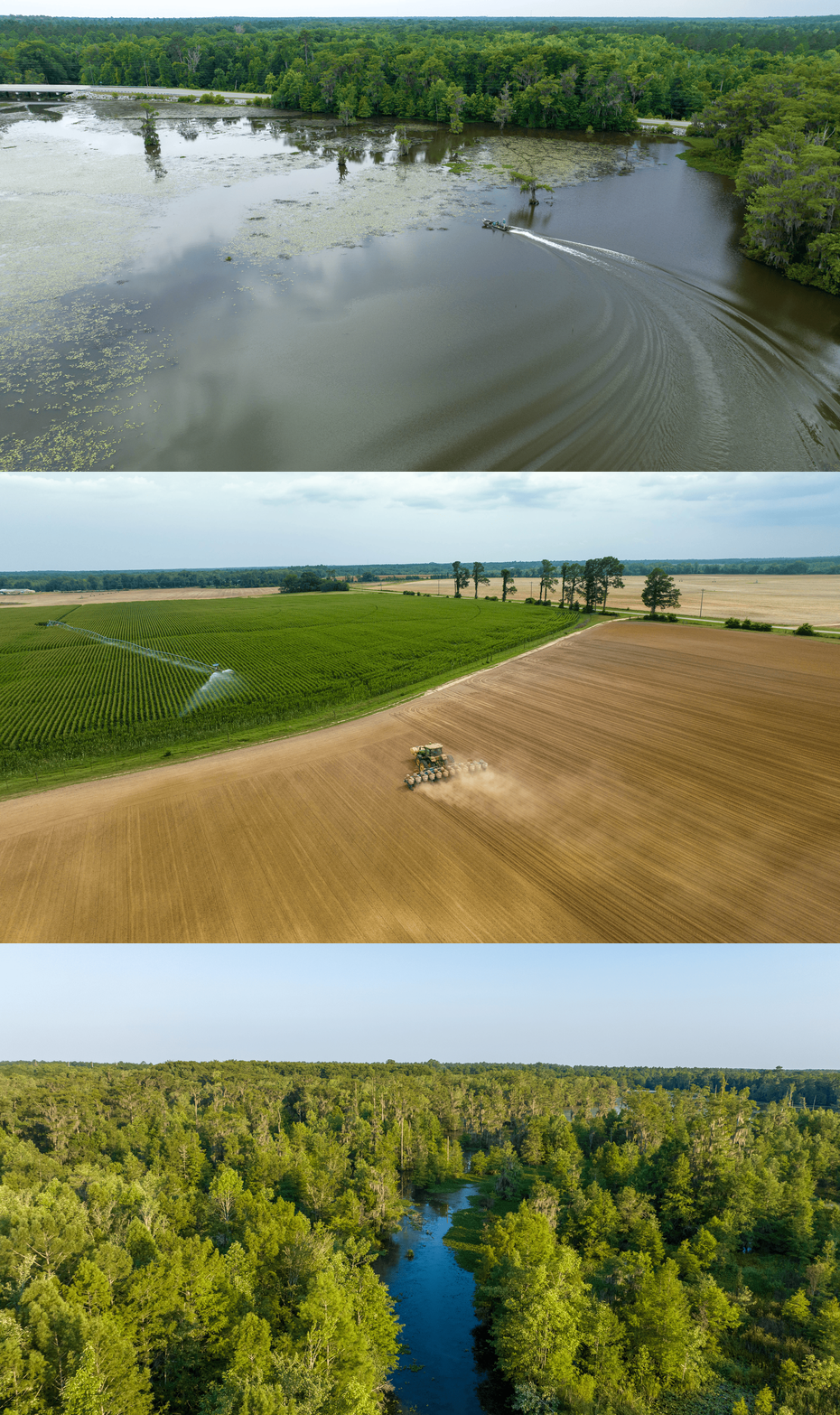 The Albany Area Plantation Belt is full of beautiful, finished showplaces — manicured, filling the majority of 300,000 acres. Cordray’s has that too. But it also has the exact opposite: wild creek bottom, flooded timber, and swamp cover where old bucks get older. A place you can get lost. A private lake system you can get lost in. Deer that have lived and died and never seen a hunter. A place for wild adventure. A place that feels like it did when the Muscogee named it the place where the deer sleep.
“The first time I went up the Ichawaynochaway Creek, it felt like you were going back in time — an untouched part of the world you could never replicate. The size of those cypress trees, the canopy. There’s unlimited variety, like you couldn’t find anywhere else.” — JR Wright, Owner
This is built for the sportsman — someone with a passion for hunting all game, who prefers mature whitetail above the rest. It has the parklike pines, the wild quail, and the income-producing farmland Southwest Georgia is renowned for. But it also has what those places don’t: a 250-acre mill pond and its associated wetlands, sloughs, and hardwood drains — plain and simple, perfect deer and waterfowl habitat. And the lake and the dammed creek are private. Thanks to one of its most famous neighbors downstream, the Georgia Supreme Court declared this water private to its landowners. Not public access on posted river frontage.
It has quail — good quail, with room for far more. It has exceptional dove, wild turkey, and waterfowl numbers and diversity that outpace most plantations by a long shot. But make no mistake about what this is. For someone who wants to own and control mature whitetails in Southwest Georgia, this is arguably the finest deer-purposed property one could hope to find. You are buying a sanctuary — control of the corridor the big deer use.
"I owned Centerville Farms, a thousand acres of beautiful, manicured quail plantation. The hunting was great — I harvested a lot of good bucks. But there isn’t anything as good as deer hunting the wetlands, the mature hardwood bottoms, and the flowing creeks I grew up with. There is something magical about hunting mature deer in parklike hardwood bottoms.” — Jon Kohler
"One of my deer-hunting buddies came out and said, ‘I saw twenty does, I saw ten bucks, and I must have seen a hundred and fifty wood ducks fly over my stand.’ There’s just so much variety — it’s a really unique feeling.” — JR Wright, Owner
This property controls “the I-75” of wild game movement.
Cordray’s Mill occupies one of the most strategically located positions in Georgia’s trophy whitetail belt — where Calhoun, Terrell, Randolph, and Dougherty Counties converge. This landscape has produced generations of officially measured trophy bucks and is recognized by experienced hunters as one of Southwest Georgia’s premier mature whitetail regions. There is a reason sportsmen control and manage more than 220,000 acres directly contiguous to Cordray’s Mill.
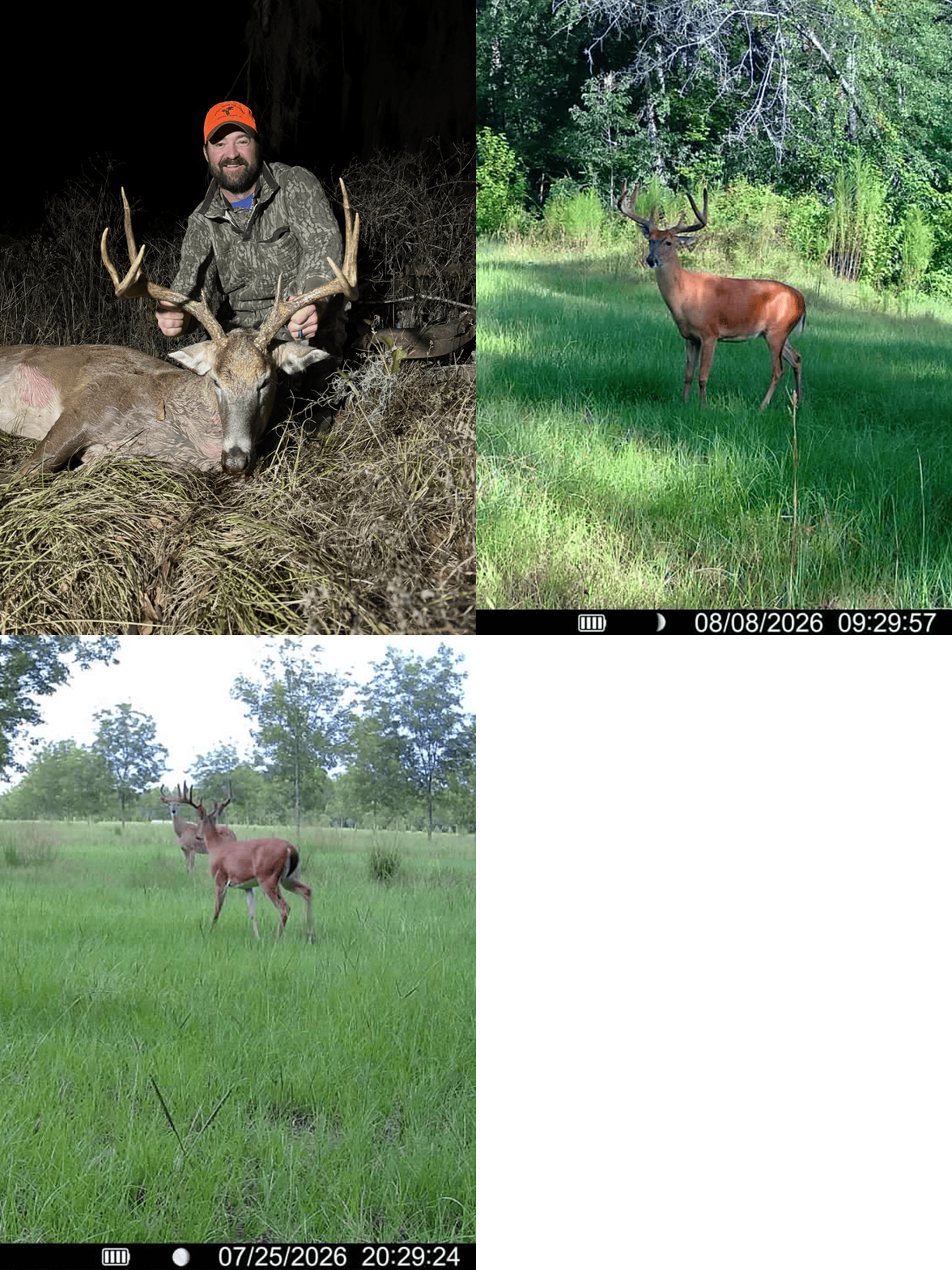 You control the corridors the big bucks travel. You have the genetics. You have the feed. You have age. You have the cover that keeps them there. Trophy whitetails don’t wander at random — they move along water, along corridors. Cordray’s controls the drainage: the Ichawaynochaway and its two great feeder creeks, the wild highways mature bucks use to move unseen for miles. They move between the agricultural ground in spring and summer and the quail plantations in fall and winter. This property sits in the middle of that movement.
When we last sold this place, it had been held as a sanctuary for close to two decades by a non-hunter. The current landowner rarely deer hunts himself. Weekend guests have taken the few harvested bucks pictured. The property has not been managed for deer — no protein feed, no food plots. That is exceptional for a place relying on agriculture alone.
“What makes it really good is the swamp. These deer live down in the swamp — their legs are almost black. There’s just not any human pressure here.” — Chris Peake, Plantation Manager
“Our neighbor to the north just shoots one trophy a year. Two years ago he killed a 175-inch ten-point. A big, big deer.” — Chris Peake, Plantation Manager
“The vacuum comes on, and they know where to go to feel safe. The deer don’t want to be around the quail hunters, and they can’t be out in the open in the ag fields all the time. So they find this safe haven, this refuge, that has everything they need to survive and thrive. And that’s Cordray’s Mill Plantation.” — JR Wright, Owner
“I’m an average deer hunter at best — but I’ve got friends who are really good, who’ve killed some really big deer. Year after year they call and make sure they can still come hunt Cordray’s Mill. Because they know: they can come shoot a deer at Gillionville, but it’s not gonna touch the size of the deer over in Calhoun County — specifically at Cordray’s Mill. Every year, I get the call: ‘I broke last year’s record.’” — JR Wright, Owner
If you want to learn more about why and how Southwest Georgia became the South’s #1 place to harvest Boone & Crockett whitetails,
our Woods N Water article on it is our #1 requested back issue. Woods N Water link HERE.
Today’s recreational lands
"When I started in this niche 35 years ago, there was no such thing as recreational land. Land was valued on agricultural production or timber, so wetlands and ground used only for recreation were the least valued and least desired. Where I was raised, 75% of the landowners sold their least desirable riverfront land to the State, thinking they had given up their ‘unproductive’ ground. Today the roles have flipped — that would now be their most valuable land. Recreational land commands a premium even over irrigated farmland. Healthy wetlands are the cradle of what creates the most value in recreational land: trophy deer hunting.” - Jon Kohler
“People today are seeking adventure — places they can enjoy God’s great outdoors with others. The wilder, the closer to the way God made it, the better.”
The Layout Advantage
Not all hunting land is created equal. The genius of this place is how the cover, the edges, and the habitat are arranged. The bucks’ sanctuary and travel corridors sit apart from where you recreate all day.
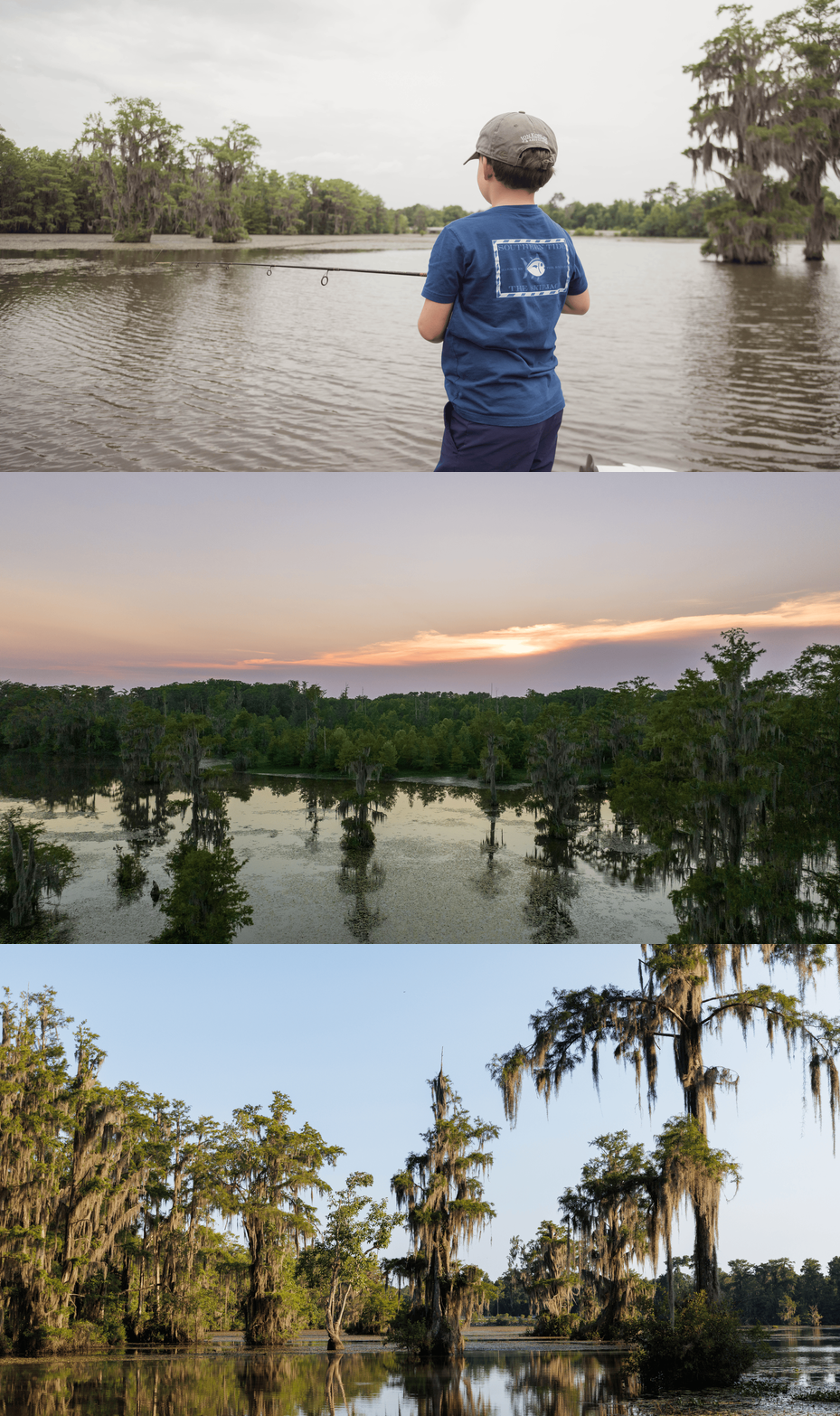 Run ATVs with the kids. Run dogs. Ride the roads, fish, do whatever you like — and never blow the deer, turkey and ducks out. And because the game is spread across so much cover, Cordray’s can hunt more people than you could ever put up stands for. This isn’t a one-family, one-stand property. Bring the whole camp.
“Imagine waking up before dawn, watching the sun poke through the pine plantations before you walk into the low ground and ease down the creek bottoms to call in that gobbler. Just hearing the return call from that gobbler is amazing. And no matter the outcome, you go have lunch at the cabin — and then a little bass fishing until the afternoon hunt. I’ve had days I’ve caught forty bass on that lake. We cleared out the creek so you can drive straight from the back of the cabin right out into the main body of the lake.” — JR Wright, Owner
“You truly can use this property all year round. Most places around here, people come down in dove season and by the end of turkey they’re gone. Here, you’ve got the ability to use it all the time.” — JR Wright, Owner
And Then There's Water…
One of Georgia’s largest privately owned waterways.
Nearly 250 acres of private mill pond — flooded cypress, open lake, and permanently flooded creek. It’s the largest private mill pond in the South.
“It’s probably the most unique body of water you’ll find in Southwest Georgia — if not the Southeast. You’ve got two and a half to three miles of frontage on the Ichawaynochaway, a duck impoundment, everything from bottomland to pine plantation. And it’s navigable through most of our property — you can run it from the dam all the way up to the pecan orchard. You can fish the creek, you can fish the lake. That’s hard to find in private land these days.” — JR Wright, Owner
“The Mill Pond is like an episode of Swamp People. It’s huge. At around 250 acres flooded, it took two hours just to film half of it. Waterfowl everywhere. Fish. It’s like nowhere else. I have mud boats myself — I love this stuff. But it takes time to come to the realization that this is completely private. You expect to see other people. Instead you see wildlife everywhere.” — Jon Kohler
The bass, bream, and crappie fishing is exceptional — this lake once carried its own private fishing club. The waterfowl is the star of the region: thousands of wood ducks, mallards, ringnecks, gadwall, and teal on water that has never been pressured. Not your passion? The duck hunting alone can be leased for a considerable annual sum, and so can the fishing.
“I’ve seen every species of duck out on that lake — ringnecks, teal, mallards, woodies. Some years there’s been more teal than wood ducks. I’ll never forget the first time we killed one of everything, and thought — you could travel a long way for this variety, but here we are in Albany, Georgia, killing four species in a day. And there are two great spots off the lake for floodable planted duck ponds, if somebody sees the vision.” — JR Wright, Owner
“So on the backside of the pond, there’s probably 20 to 30 acres of great waterfowl habitat… you limit out pretty quick.” — Chris Peake, Plantation Manager
“Water is the new gold. The question is how does one harvest it. Its one of the last privately impounded creek systems in Southwest Georgia. It was done in the past for irrigation, which this proeprty still benefits and recreation. In fact, Cordray’s Mill was the location of one of SWGA’s first pre-Disney resorts. It has a dance hall, swimming pool and more.” - Jon Kohler
Species: Largemouth bass · Bream · Crappie · Wood duck · Mallard · Teal · Ringneck
Heritage & Privacy — The Creek That It Took Power To Close
Ichawaynochaway is Muscogee for the place where the deer sleep — the Creek people called it Sleeping Buck Creek, naming this very land for the animal you would buy it for. Arrowheads still turn up throughout the property. This has been one of the most game-rich creeks going back to the beginning of time. It is no coincidence that the nation’s top sportsmen own land here — and conflict over who controls the hunting on it runs into the modern era as well.
“Farmers have picked up quite a few artifacts over the years. Where those creeks converge, there’s a real concentration — it would’ve been a village.” — Chris Peake, Plantation Manager
Downstream, this is the creek Robert Woodruff — the former president of Coca-Cola — chose for Ichauway, his legendary 29,000-acre plantation, where he hosted President Eisenhower. Today it is the Jones Ecological Research Center, and the stretch of Ichawaynochaway running through it is some of the most protected water in the South.
Why your water is untouchable — a creek the courts made private.
When the Woodruff Foundation closed the Ichawaynochaway to boaters in 1992, a five-year fight followed — an “Ichauway Coke Party,” a raft floated with a goat and a bale of cotton to argue the creek was navigable, even arrests. It ended at the Georgia Supreme Court in 1997, which ruled the creek non-navigable and private. “No Boating” signs still line it.
And it isn’t a privilege unique to Woodruff’s property. Because the creek is declared non-navigable, Georgia law gives any owner of both banks the same right to keep the public off — and Cordray’s controls both sides of its creek frontage on the north and one side on the south. So the water is sealed: the mill-pond dam blocks any boat from the north, and downstream the creek is non-navigable all the way to Woodruff’s posted Ichauway. Your creek — free-flowing to the south, flooded to the north — is as private as water gets. (Source: Givens v. Ichauway, 268 Ga. 710 (1997); Georgia non-navigable-stream law, OCGA § 44-8-2/3.)
“The Ichawaynochaway is one of the most storied bodies of water in Southwest Georgia. And this water that runs through Cordray’s for miles is your private waterway. No kayakers. No public interference. True privacy. I don’t see how you could ever replicate this again — it’s something you can show the world, and people raise their eyebrows every time.” — JR Wright, Owner
“There are few places as historically relevant as Cordray’s Mill. Everybody knows the mill pond. It used to be a resort — they had the pool, the dance hall, the grist mill. I’ve got friends from Albany in their seventies who swam in that mill pond as kids. The history is just oozing out of it.” — JR Wright, Owner
You are surrounded by legends: the 5,600+ acre Notchaway Plantation along your entire eastern line, the 24,000+ acre Deer Run just beyond it, and Woodruff’s 29,000 acre Ichauway down the creek. For wild game flow, it does not get any better.
Recommendations
Right now, Cordray’s Mill is also a working property with income already in place: 239 acres of irrigated farmland — five pivots, three pumps, drawn from your own reservoir — leased alongside the pecan grove and pasture for about $70,000 a year.
“The two biggest fears someone has about owning a trophy deer place are, one, can it consistently produce trophy bucks, and two, is there something unknown preventing that? Where is the weak link? I raise trophy deer on my own place, Lick Skillet, and I sell trophy deer places across the South. To me, the single biggest issue is high-quality protein. The farmland here is great, but I would have the farmer incorporate perennial peanut. It is essentially the alfalfa of the South — exceptional protein through the summer growing season, and you can overseed winter feed on top of it. I have been growing it 35 years on my place. You can always add protein feeders, which I do as well, but that is an out-of-pocket cost. Right now there is good feed but it’s not as good as it could be." — Jon Kohler
Land that pays you — on your terms.
Right now, Cordray’s Mill is also a working property with income already in place: 239 acres of irrigated farmland — five pivots, three pumps, drawn from your own pond — leased alongside the pecan grove and pasture for an amount that would pay the salary of a full-time plantation manager.
The Sauls family farms this land, and they are also neighbors to the west. They are bird hunters, and they are renowned and respected as some of the best farmers in the region.
“If you want revenue, the farm lease produces it — that’s what I’ve elected to do. Or you could take that irrigated ground back to quail habitat, and after a few years have a great quail operation and some merchantable timber. On the southern 440 acres we’ve got big stands of longleaf, and we see wild coveys in there all the time — twenty-five birds blow up off the road. You’ve got room to put ten or twelve coveys out.” — JR Wright, Owner
The rare part is that you have a choice. Keep the farm lease as passive income. Or convert the pivots into more habitat and perennial peanut — the best trophy-deer forage in Georgia. Or convert the farmland into wild quail habitat the way neighboring Notchaway did, and build another wild bird course. If waterfowl isn’t your passion, the duck hunting leases for a substantial sum. Private waterfowl habitat of this caliber is something even the wealthiest owners across those 300,000 plantation acres do not have. The same goes for the fishing.
“Where I’ve missed out is the trophy deer and the dove — the sheer number of dove that fly over this place. We’ve laid the foundation with a good dove field, and it’s been outstanding.” — JR Wright, Owner
"Converting the pivot land into quail habitat is a force multiplier. Spring drought is ultimately what dictates fall bird counts — irrigate and you eliminate that concern. These converted lands also carry the lowest predator density, so survivability is off the charts. It wouldn’t be a hard decision for me. Plus you would be creating wealth while doing it." — Jon Kohler
Social Storm ® Property
Coined and trademarked by Jon and Erica Kohler — a Social Storm® Property is one investors gravitate to for safety in bad times and buy for the recreation reward in good times. What was once a quiet submarket first discussed in 2010 went completely mainstream with COVID. For families it replaces gold and silver as the modern-day hedge of choice. It is land that holds hard assets — water, timber, soil, and safety — while delivering world-class recreation. Two asset classes bound together in one acquisition.
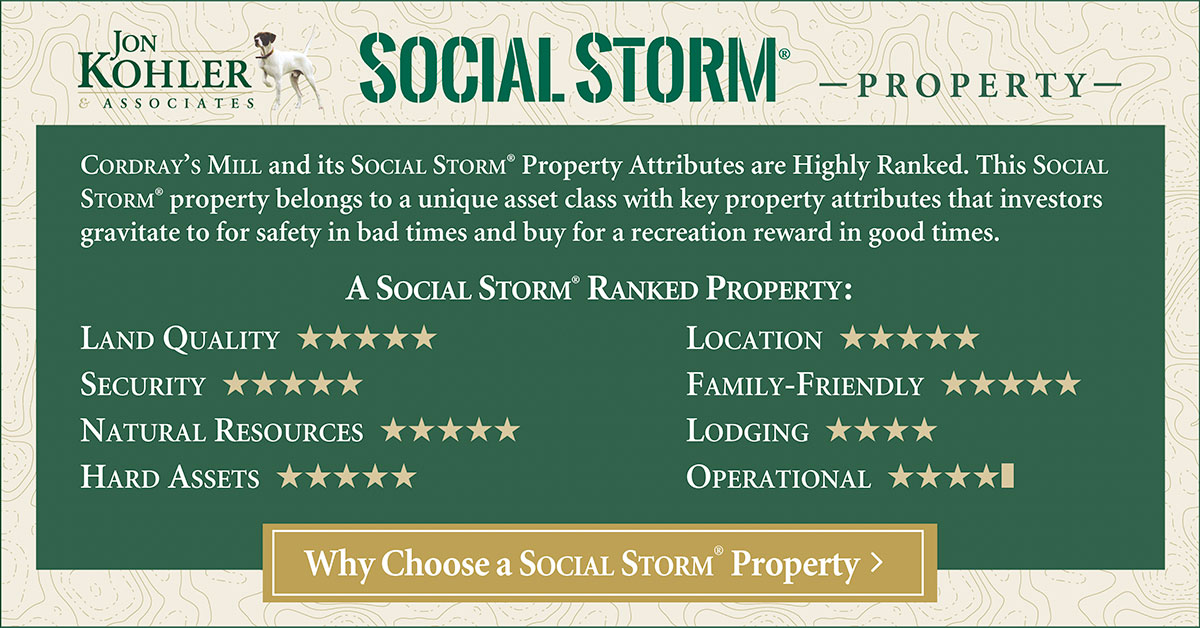
"We first trademarked that term over 15 years ago, when we noticed people were buying some of these lands in case things went bad. It’s hard to imagine that before COVID there was a feeling of shame about being worried. Sadly, today everyone’s concerned. The good news is that the properties scoring highest are also incredible hedges. History has shown they increase exponentially in value during bad times, yet track the consistently increasing recreational market during good times. For many, these properties are a useable replacement to gold and silver.” — Jon Kohler
“There are few places you’d hope to end up if we ever had another COVID-like event, or worse. Comfortable accommodations for a family or two. Riparian water rights. Agriculture in mass — on your own place and all around you. Abundant wildlife. If you had to live off the land, you could never describe a place better than Cordray’s Mill. And there’s a community around it that sticks together — good people, who’ve helped me on numerous occasions.” — JR Wright, Owner
"I am happy to share my recommendations on what can easily be done to make this property even more self-sufficient — things I have done at my own place with solar, solar pumps, and other techniques." — Jon Kohler
Two Complete Properties
GA-45 splits Cordray’s into two complete, self-sufficient properties, joined by private bridge crossings. That is what makes an eight-figure decision easier: buy the whole and hold the option to sell either side, or go in with a friend and each take a world of your own.
Picture it — one partner takes the North, one takes the South, and together you build a deer camp like no other: year-round, for families, with trophy whitetail, ducks, fishing, and farmland all inside the gate. No flights to Iowa. The genetics, the crops, and the age are already here.
North — 1,002± acres (N of GA-45): 1 mile of flooded Ichawaynochaway · 1.35 mi both sides of Falling Creek · the creek “marriage” confluence · the ≈250-ac private mill pond · 36-ac pecan grove
South — 440± acres (S of GA-45): 1.3 mi free-flowing Ichawaynochaway · 1 mile both sides of Pruitt Creek · wild, undammed creek out of the 1700s · upland, timber and creek-bottom cover · prime south-side buck bluffs · big longleaf stands holding wild coveys
The Lodging
There is no million-dollar lodge on the place — so you are not paying for one. The existing homes are honest cabins with rustic, historic charm, ready to serve as guest quarters from day one. Others are leased out to neighbors.
There is functional lodging, including an unfinished camp on the creek as a blank canvas, plus two equipment barns and some equipment included. The upside is what you build.
“My predecessor did a great job with these cozy, comfortable cabins — I’ve leased some out for revenue. But if you wanted a barndominium for entertaining — take out the grain bins, replace the shop, right there toward the landing. You’d look back into the swamp, overlook the farmland or your newly planted timber at sunset. It sits up high, you feel the breeze. That’s your true headquarters — in a spot already used, but not maximized.” — JR Wright, Owner
Assembled once. Impossible to replicate. Released maybe once in a generation.
A property’s real value isn’t measured in acres — but in what it lets you do, and who you get to be there.
We are all searching for an adventure. A place to share God’s great outdoors with friends and family. Here, it is also combined with an incredible investment.
In good years, Cordray’s is where you gather everyone you love and chase the finest deer, ducks, and fish in the South. In hard years, it is a private, productive world that takes care of itself, and of you.
“I can only sell this place as well as I can because it’s an incredible place. I’ve been fortunate to share it with my children, my friends, and my family. I’ll miss it deeply — but the next person will hopefully enjoy it every bit as much as I have.” — JR Wright, Owner
We know what is on the line here. What keeps most from accomplishing their dream. The fear is never the price. The fear is being wrong about the place. The fear is the unknown.
Who You Are Buying It Through
Jon Kohler & Associates has been a specialized recreational and sporting land brokerage since 1991. Third generation. More than $4.8 billion closed across 350,000-plus acres in Florida, Georgia, Alabama, and South Carolina. Jon is a two-time APEX National Recreational Land Broker of the Year, 2022 and 2025. He holds a law degree. Our firm literally “wrote the map” on these properties.
Let our knowledge, our combined experience show you too the right path to accomplishing your dream. The pursuit of properties like this is a specialty niche. Treat it as such.
Behind every position we take is the JKA Land Registry — our proprietary record of nearly $2 billion in private, non-MLS recreational land transactions, with the deal-maker commentary behind them. It is why we do not price land by averaging comps. On a market-of-one asset, there are no comps to average.
We live the lifestyle we sell. Jon also owns and manages Lick Skillet on the Aucilla River, and raises trophy deer on it. The recommendations in this presentation are not theory. They are what he does on his own place.
One. Call. A direct conversation with Jon opens up knowledge and experience for your benefit. A broker’s role is to guide you to help accomplish your goals. To show you not just the right path but where others before you stumbled. To lead you to a safe and profitable adventure through land ownership.
Broker’s Comments
The Kohler & Associates’
Difference
Didn’t find what you were looking for? Or want to discuss the market with the Leader in this niche?
Contact us to discuss one of our properties, for information on properties that are not yet released to the market or to discuss the market.