
by Jon Kohler With Additional Writing & Research by: Scott Sumner
If you are a sportsman in Florida, consider yourself fortunate on many fronts. Since 1776, despite 250 years of ever-increasing laws and regulations, today’s Florida is arguably the most free state in the Union.
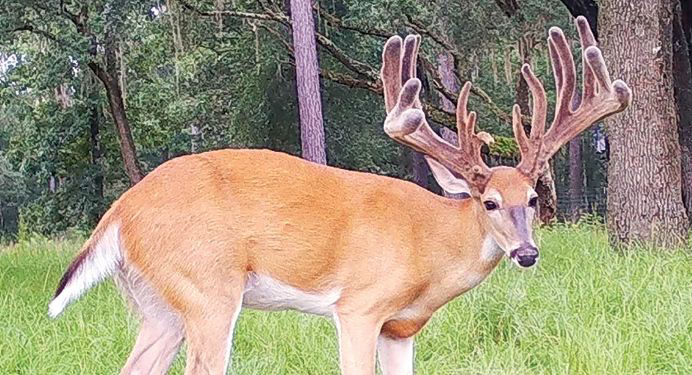
Among my most-cherished freedoms is the ability to hunt and fish. One of my favorite species is the whitetail deer, a sentiment most sportsmen share with the first Floridians and Europeans, who arrived here five centuries ago. There is a sense of reverence a large buck commands, and few places compare to modern Florida when it comes to season length and the right to raise and grow these great deer.
In my line of work, I get to meet a lot of interesting people who share a passion for our land and its history. I have had the chance to interview archaeologists such as Dr. James Dunbar, chair of the Aucilla Research Institute in Monticchiello, Florida, who found such amazing discoveries as proof of the first Florida people’s interactions with saber-toothed tigers, short-faced bears, ancient bison, mastodons and even ancient armadillos pushing the size of my 1981 Jeep Scrambler.
I imagined all the different hunting opportunities and was curious about the different species hunted over time. It came as quite a shock that then, as now, the early hunters’ foremost targeted species was the whitetail deer. Deer bones are found in almost every ancient campfire. Archaeologists, one after the other, confirmed whitetail deer are directly tied to Florida’s people since the beginning of time.
Fast-forward 500 years to the beginning of Florida’s first trade economy. The whitetail deer was the most economically-important game species for indigenous people, such as the Apalachee, considered to be one of the most advanced and powerful of the Flor-ida tribes. From at least A.D. 1000, this group of Native Americans inhabited Northwest Florida between the Aucilla and Apalachicola rivers centered around Tallahassee.
Both hunters and farmers, their ability to grow crops such as corn, beans and squash, along with skills as hunters so great that one village, just a few blocks away from today’s capital, had enough extra food to “host” Hernando Desoto’s 620 conquistadors and 300 horses all winter. The deer population, in particular, was hunted for its food after the Spanish encountered the Apalachee. Deer hides became America’s first currency, which is where the dollar bill’s nickname “a buck” later came from.
David Ward, also of the Aucilla Research Institute, states, “Deer were a good source of protein. The whitetail deer was important for the survival of the Native Americans that were here when the first Europeans got here.”
Dunbar further notes, “The Apalachee were particularly known for their bows. Cabeza de Vaca (Spanish explorer) first came through with Narvaez in 1528. The Apalachee longbow caught the attention of that first expedition.”
I can only imagine what these hardened conquistadors thought when they realized they didn’t have the strength to pull back the Apalachee bows!
After their hopes for gold faded, a host of 53 Spanish Missions lined the region. Their main purpose was to tell the Apalachee about Jesus and trade for deer hides (the closest thing they found to gold), which they transported to St. Augustine for shipping to the Old World for a profit. I never really thought about exactly how, in the 1600s, one would get that many tanned deer hides to St. Augustine until David Ward first told me about the Tocobaga.
These natives were the first “maritime experts” and were based in the Tampa Bay region. One of their chiefdoms was essentially retained by the Spanish to move to the headwaters of the Wacissa River and transport deer hides and other goods to Saint Augustine via a fleet of dugout canoes. I can’t imagine paddling a huge load of hides from the Aucilla down the Gulf of Mexico to about Cedar Key, then up the Suwanee River, up the Santa Fe, then portaging overland near Orange Lake, then into the St. Johns River. Now that’s a shipping company!
The reverence for these first bow hunters reminds me of my friend Bob Williamson. Bob is an uber-successful businessman, passionate deer hunter and a Christian mentor, or maybe better described in today’s world as an “influencer” for Jesus. After he sold one of his companies for a fortune, he founded the famed Honey Lake Plantation in Madison County. He lined his office with the finest woods of heart pine, pecky cypress and cedar meticulously laid by the best craftsmen. It reminded me of what King Solomon would have built if he were a Florida cracker.
There, front and center, where one would expect to see the Ark of the Covenant, was this huge flint spear point about 10 times larger than anything in my own arrowhead collection. To Bob, this one-of-a-kind point represented his own accomplishments, and he wondered what tales it could tell about the “warrior” and hunter who certainly once owned it. This continued until one day, while showing it off, an expert casually mentioned that it was a great example of an Apalachee farmer’s hoe. It was likely used to plant sweet potatoes or squash by a child or woman, but certainly not by a “warrior,” and never used to hunt anything. Like a bolt of lightning, this treasured heirloom went from prominence to disgust, and no one ever saw the hoe again. It was like someone took back his “Small Business-man of the Year Award.”
Exploring the whitetail deer’s noteworthy place in Florida’s cultural past helps us understand and appreciate how they came to be so ingrained into our psyche.
With today’s wealth and knowledge, some landowners are taking it up a notch by bettering their own deer herd in ways previously unimaginable. Florida is one of the states that offer the freedom for a landowner to put up a high fence. With what we have learned about deer over the last 500 years, this is making a big difference.
When I drive down the road and see a high fence, it’s the same as when I see a property with a conservation easement. I immediately know the land-owner is heavily invested in improving wildlife habitat above any other uses. I like that. Those are my folks. They also almost always use prescribed fire, but that’s another subject. The subtleties can be missed by many, even those on my own staff.
Just last week, we were filming a 200-acre high-fenced property for our latest short film. There was about one adult deer per acre on that property. In perspective, as a general rule, average woodlands have about one deer per 16-20 acres. Despite filming and droning during the peak of fawning season, we saw no deer, to everyone’s surprise, but the landowner and me. Yet, later that 90-degree afternoon, only a few miles away and while on a cattle ranch on the Santa Fe River, we saw deer herd after deer herd, including numerous fawns running everywhere. Why the difference? The high-fenced landowner invested in deer habitat.
During fawning season, it’s imperative that good cover protect the vulnerable fawns from predators. Like getting wild quail and turkeys to the age they can fly, so too getting fawns to the age they can outrun predators is job #1. While enjoyable for all of us to watch at the Santa Fe ranch, the fawns committed the
ultimate sin, being seen running across the landscape, flagging their white tails for every predator to see but nowhere to actually hide. What the high fence land-owner also knew is in addition to all the cover he grew, his high fence kept out most fawn-eating predators.
When I am looking at land issues, a “quick check” I use to determine how things should really be is to go back to how God made it before mankind messed with it. When it comes to the correct buck-to-doe ratio, I don’t have to use my quick check to know that one decent buck per 5-10 does (which a lot of our lands have) isn’t right.
With work, these guys with a high fence are able to get things back in syncwith the perfect 1 to 1 ratio. There is something exciting to see when someone improves their land to accomplish these goals.
So, the next time you drive down the road and see a landowner exercis-ing his freedoms by investing in habitat, building a high fence, see a well-man-aged hunting property or lease, or see a big orange “smoke ahead” sign, please be reminded that over the last 1,000 years, many things have changed, but one thing stays the same – our passion for the whitetail deer!
Thank you, Lord, for these lands. In the words of Wendell Berry, “What I stand for is what I stand on.” That seems pretty appropriate to me.
 From murky farm ponds to pristine glacier-cut lakes and everything in between, Knox Daniels’ expertise stems from a lifelong fascination of water and the creatures that live in and around it. He recognizes and helps clients appreciate the value water features bring to a property. “My goal is to help buyers realize and sellers maximize the value different water bodies bring to a property, not only in a recreational sense, but also for social storm reasons.” After extensively traveling the country for collegiate BASS fishing tournaments, Knox graduated and worked for the Southeast’s finest fisheries and wildlife biologist, Greg Grimes. With Grimes’ company, AES, Knox managed many of the southeast’s finest private lake estate/impoundment properties, and learned the intricacies of upscale property management. Learning from Greg and other biologists, Knox honed in on the specific conditions and habitat needed for optimal gamefish growth in private lakes. He has also worked as a property manager on several thousand acres and for a commercial developer, facilitating the dirt work and builds of several apartment complexes, but his true passion has always been in the outdoors. “I’ve always had an insatiable fascination with ponds/lakes and am grateful to be able to help to place clients on the properties of their dreams and make their personal fisheries/wildlife goals reality with JKA.” – Knox Daniels
 Jason has been assisting landowners for the last 28 years in Georgia and South Carolina obtain achievements the owners did not realize were possible. His degree in Biology from Georgia Southern stemmed from the desire to know how things in nature work. His plantation roots began at just 16 years old outside of Albany, GA and the last 20 years were spent in the Lowcountry of South Carolina. His entire career has been spent developing a global approach to plantation management. That plan included sales. Sales is in Jason’s blood- his mom had a 45-year career as a real estate broker. After college, he chose to pursue his passion of making properties great. In 2011, Jason sold his first plantation. Since then, he has assisted buyers and sellers with over $20 million in sales while most of that time working as a full-time General Manager of a large Lowcountry plantation. Today, he is committed to using his unique skill set and experience to guide landowners through the many challenges of plantation ownership.
 Bruce Ratliff is a retired elected official (Property Appraiser Taylor County). Bruce brings years of experience in ad valorem tax knowledge. His property tax background gives JKA Associates & clients a unique insight into the complicated tax process. Bruce held several positions in the Florida Association of Property Appraisers, including member of the Board of Directors, President, Vice-President and Secretary, and served on the Agricultural & Legislative Committees for the Association. The real estate business has been part of Bruce’s life since childhood. His mother, Shirley Ratliff owned Professional Realty of Perry, Florida and his father, Buster owned Ratliff Land Surveying which Bruce was General Manager of before his political career.
 Hailing from a long line of outdoorsmen, Tim learned a great deal from his father and grandfather. He saw first-hand what it means to be a good land steward. He believes land is so much more than a place to hunt, fish, and grow timber or crops. “It’s an identity, a resting place, a safe haven and a way of life, said Tim.” Tim’s family ties to Alabama run deep. During his grandfather’s first term, Governor James was responsible for signing into law Alabama’s first state duck stamp which helped to ensure funding for the procurement, development, and preservation of wetlands for migratory waterfowl habitat. He also established Alabama’s lifetime hunting license, so it is no surprise that Tim is an avid outdoorsman with a keen eye as to how best to improve habitat for the greater good of its wildlife.
 With Madison County roots, Lori grew up on her family farm at Pettis Springs along the historic Aucilla River. A love of the land was instilled in Lori very early on by her father who was a local farmer. Lori understands the importance of good land stewardship and has witnessed first-hand how her own father, a former 2-term member of the Florida House of Representatives whose district encompassed many rural counties of the Red Hills Plantation Region, with a little bit of sweat equity, so lovingly worked their own family land. These are core values she carries with her today, and nothing gives her more personal satisfaction than to represent some of the south’s best land stewards.
 Cole’s dedication to land management lies in his family roots. As a fourth-generation timber expert, Cole’s earliest memories were spent with his father managing timber investments. With a degree in Food Resource Economics from the University of Florida, Cole is the epitome of an up-and-coming leader. He grew up with a hands-on approach to learning land management and conservation and has spent the last 15 years learning every angle of the real estate and forest industry. Cole is a member of the Florida Forestry Association, Red Hills Quail Forever, Southeastern Wood Producers Association and he uses this platform as an advocate for landowners and their land investments. His family has dedicated the past 60 years to providing landowners in North Florida and South Georgia with professional land management services focused on improving and protecting one’s forestland and wildlife investment. In fact, their family business, M.A. Rigoni, Inc., was one of the first to introduce whole tree chipping to the Red Hills Region.
 As a landowner of his own family farm, Lick Skillet, along with family land that has been passed down and enjoyed together at Keaton Beach for 40 years, Jon knows what it means to be a steward of the last best places. As a third-generation land broker with more than 30 years of experience in advising landowners in this niche, Jon is known for his innate ability to harvest a land’s unique intrinsic value. Touting several notable sales under his belt, Jon personally closed Rock Creek/Molpus – 124,000 acres of premium timberland at $142,000,000 – which was known as the largest timberland land sale in the Southeast for eight years running. He is a co-founding member of LandLeader and achieved the real estate industry’s highest honor, “2022 National Broker of the Year – Recreational Land Sales,” by the Realtors® Land Institute.