
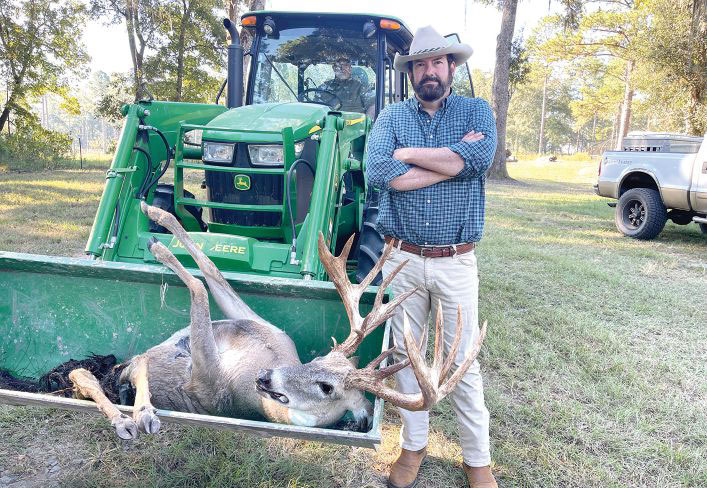
by Jon Kohler, JD
All of us work on improving habitat because we love it. Some of us work on habitat with all the diligence of managing a professional sports franchise.
Today, that’s not far off – and this story shares why. My dad always wanted to buy any land that bordered us. My mom always wanted him to stop.
Blue Creek is natural Gulf Coast hammocks, longleaf and tidal rivers, and he loved it a close third behind family and God.
But my mom had had her fill of land that cost money instead of making it, and my dad lost the argument every time. It was the first time I heard the word divorce.
Listening through the walls, I cringed at how poorly he made his case. I was 14 years old. He never heard the promise I whispered through those walls.
One day, I would build us the winning argument – and I did. While we still own Blue Creek, he never lived to see today’s recreational land market. If you’re like many of us who take wildlife management to a professional level, the costs are high. The annual return is measured financially in sporadic timber harvests and intrinsically in shared experiences with friends and family.
You’ve spent good money – and even more time – on habitat that doesn’t show a return on any spreadsheet. It’s a hard case to make to your spouse, your accountant, sometimes just to yourself. The financial data has finally caught up.
Doing right by the land is now one of the best-performing investments in America. Prescribed fire is more than habitat management – it’s reinvesting in a Blue-Chip stock. We can show a $2,000-per-acre difference between consistently burned land and neighboring timberland that isn’t.
A-grade recreational land is now worth 40%+/-more than A-grade irrigated farmland in the same county. We’re closing the best at $10,000 an acre. One of our properties just proved 132% appreciation in five years on land carrying a conservation easement – meaning it can never be anything but recreation.
And, the largest recreational land sale in Georgia history just closed for $39 million, in a story that reached over a billion people. My dad would have won the argument today – and it wouldn’t even be close. Here’s how.
What “Improvement” Actually Costs
Sometimes the most valuable lessons come from the worst cases. A few years ago, a past client of mine – whom I won’t name – owned a significant amount of old, natural longleaf and wiregrass.
Keep in mind: of the original 90 million acres of longleaf, only 5.6% remains today, and only about one-hundredth of one percent still carries the original wire-grass virgin ground cover, like his did.
I sold about 4,000 acres of it and brought in a buyer for what is today one of the most famous, well-managed sporting plantations in the country. It was a record sale that shocked a lot of people and demonstrated the land’s value that most never saw. I thought he was impressed. Apparently not.
The very next thing I knew, he was clear-cutting a vast stand on another tract to convert it to irrigated farmland.
Not only did removing the 200-year-old stumps cost as much as the timber was worth, but he had to drill a prohibitively expensive 800-foot well – past the Floridan aquifer, into the Claiborne formation – to feed a new center pivot.
Just like that, one of the rarest landscapes in America was, once again, converted to commodity production. Why? Because the model he used to value the land was based on the past. He didn’t see the intrinsic value, even though he’d just watched it pay.
For some reason, he reverted to looking at land the way the corporations and Wall Street do – and by those metrics, conversion looked like a sound business decision, just like it had for the other 85 million lost acres.
The biggest mistake?
Not understanding how to monetize
the intrinsic value of the 100th of 1%… the wiregrass. He only looked at the merchantable timber value. My unnamed client took something rare and made it a commodity. The Rembrandt was ruined trying to make this painting look like something more recognizable to most.
Lick Skillet: What
We Actually Raise
Now go to the other extreme. Our family farm, Lick Skillet, sits on more than two and a half miles of the Aucilla River – the site of one of the first two ranches in Spanish Florida.
Unlike that pristine longleaf and wiregrass, my place had been farmed, cut over and exploited for nearly 400 years.
I once had a chance to buy a “per-fect,” almost untouched place. To do it, I would have had to sell Lick Skillet. Like a Southern Baptist preacher – what use would I be pastoring to a perfect congregation?
I realized what I love is the same thing Jesus’ story is built on: redemption.
Taking the sins of the past and making the land better than it ever was. We do it all. We have both low and high fence, hatch bobwhites and ring-neck pheasants, and raise whitetails, blackbuck antelope, Iberico pork and wagyu cattle. All of it based around bird dogs.
Sure, we have timber, but I saw the writing on the wall years ago. Today, we mostly plant chestnuts, pears, plums and various oaks. In fact, I got a lot of my ideas from Wildlife Trends.
What we do differently is look at habitat from additional perspectives. To justify what I do at the scale I do it – to my wife, unlike my dad – I have numbers. That comes in the form of making the land worth more. A lot more.
When I improve habitat, I look at it as a capital improvement that increases the property’s value. We create places. Beauty. Destinations. I don’t look at it as raising crops, timber or even wildlife. I create experiences. Positive, beautiful experiences shared with others in God’s great creation.
There’s something Biblical about improving land. It was the original assignment, after all. The Lord God took the man, and put him into the garden of Eden to dress it and to keep it (Genesis 2:15). The job description hasn’t changed in six thousand years.
I’ll be candid: we’ve had bad years at Lick Skillet, too. We’ve burned at the wrong time. We’ve planted the wrong things and listened to the wrong people. We even had our breeder buck die a month before his only job for the year was to begin. We’ve made every mistake in one form or another. The land forgave us, as the good Lord forgives us – and so we keep moving forward. Certainly, converting land into more productive uses made America prosperous.
But I would argue that converting 95% of longleaf habitat for other uses has swung the balance too far.
So, would the buyers who put roughly $240 million in front of us last year – all of them calling because they wanted to invest in and improve the last of it.
Here is the most surprising statistic I can offer. Of the 17,000 acres we closed last year, the average sales price was $6,900 per acre. The places we sell are the places Wildlife Trends readers steward – the best-managed lands in the South. What the numbers tell is that managing land better than most increases its value by $1,000 per acre, or about 20%, over comparables.
Knowing that should give you an incentive to increase your burned acres as well as next year’s chestnut budget. It does mine.
Three Witnesses to the Same Truth
In my profession, I’m more of an advisor – a trusted guide – than a salesman. From that seat, I get to see how ideas, people and opportunities line up, and help line them up for others.
One of the most striking observations I’ve made is the connection between three titans, all bound to one piece of ground over the course of a century – three men who have made, or are making, a difference for all of us. Each paid the price of believing this premise long before the market did. Each is now part of the proof.
Herbert Stoddard, 1924.
A self-taught museum taxidermist gets hired by Northern owners of Southern hunting plantations whose bobwhite numbers are collapsing. What no one ties together is the parallel collapse of a newly formed asset class – quail-hunting plantations.
The U.S. government had waged a propaganda war against prescribed fire, effectively shutting it down and erasing the market value of those plantations. Stoddard’s finding – that fire is the engine of quail country, not its enemy – was so heretical that the U.S. Forest Service tried to suppress him.
So, a taxidermist funded by absentee landowners had to go up against the Forest Service and their “Dixie Crusaders” – mobile movie theaters touring the South, vilifying burners the way Walt Disney later vilified the hunter who shot Bambi’s mother. In defense, he published The Bobwhite Quail in 1931. But what most people also don’t know is that he wasn’t only an employee – he was a plantation investor and broker.
He and a partner personally assembled 26,000 acres in Decatur County, Georgia that would later become Southlands.
His own fortunes depended on persuading the world of his findings – that the way God continually renewed the land with fire was irreplaceable. He won, or none of us today would be reading Wildlife Trends or be a member of Tall Timbers.
The folks there will also tell you that the science a taxidermist turned wildlife biologist wrote a hundred years ago is basically the same science they recommend land managers run today. Witness number one: the man who wrote the rule book got there a century early.
Jim Dahl, 2010.
My mentor. Jim spent 30 years watching International Paper run Southlands as a corporate timber laboratory – “the Southlands Experiment Forest,” headquarters of a 12-million-acre forestry empire.
He came from Wall Street and was one of the first to treat recreational land as a separate asset class.
In 2010, he set his sights on the property Stoddard had originally assembled, but he had a problem. It wasn’t for sale. To make his offer enticing, he had to purchase 160,000 acres across 10 states in order to own the gem.
I ended up putting the deal together that sold off the 124,000 acres he didn’t want. That deal closed at $142 million – the largest timberland transaction in the South in a decade.
I remember thinking about his faith – how strongly he believed in what he was doing. He took the pivot out, metaphorically speaking. He never looked at timber as timber, instead looking at it as aesthetics, experiences and habitat. He restored fire on Stoddard’s schedule. He built lakes and a 30-acre duck pond. He brought the wild quail back.
The property started producing Boone & Crockett deer.
Witness number two: the man who proved that converting timberland to recreation creates wealth – and built the model. The lesson Jim taught me, and the one I see most landowners struggle with, is the confidence to treat restoration as an asset class with rules. Some fundamentals work and fundamentals that don’t.
Jake Paul, 2025.
Time marches on, Walter Hatchett and I closed Southlands at $39 million – the largest recreational land sale in Georgia history.
It’s no coincidence that Walter, too, was mentored by Jim for 27 years. The buyer, a 28-year-old boxer/influenc-er who had just won the most-streamed sporting event in history, took the $30 million he earned and put it into Stoddard’s land. When Jake and I talked about why, the answer wasn’t what the headlines made it out to be.
He told me he wanted a place where he could hunt the way he did growing up as a kid in Ohio, when his dad took him hunting. The sale introduced fire-managed lands to a global audience of over a billion people.
The Land Report named Southlands, now Paul Reserve, the 2025 Sporting Deal of the Year.
Witness number three: recreational land has gone mainstream – to a new type of buyer no one could have imagined – choosing Stoddard’s land over almost anything money could buy.
Three witnesses, a century apart, all telling the same story: the land is worth more the way God made it than the way man “improves” it. Fixing the improvement creates more wealth than destroying it ever did.
Why the Market Finally Caught Up
In economics there’s a concept called the velocity of money – the faster a dollar trades hands, the more accurately the market knows its true worth. The corollary is also true: when an asset trades slowly, the market’s published price lags reality.
Economists call this the price-discovery problem, and it’s the defining trait of every illiquid market – fine art, classic cars, rare collectibles and land. A great quail plantation might trade once in a generation.
Until it does, its real value is hidden, and the last comp on record is almost always behind where the market has actually moved. My firm counters this with what we call Intrinsic Value Velocity.
By closing enough quality transactions in this niche at a speed fast enough to keep the comps current, we reveal the truth that slow-trading markets normally hide.
For two decades, you could buy almost any quality recreational property at any reasonable price, and because there were so few comparable sales, your purchase became the next comp. There was almost no way to lose money. That’s also the same blind spot that ruined our former client’s land.
He assumed the value on his own, and he couldn’t believe we had more buyers ready to pay what the longleaf/wire-grass habitat was actually worth. Now the trade volume is finally high enough to reveal the truth.
Recent closings/closed deals we’ve made:
Lake Wautauga (private 25-acre lake): $10,000/acre.
Kissaway Plantation (1,190 acres): just shy of $9,000/acre.
Southlands (5,747 acres): $6,790/acre at scale.
Twin Oaks (1,966 acres, conservation easement): $6,400/acre land and timber value – same tract sold in 2020 for $2,760/acre (a 132% appreciation in five years).
For comparison, good irrigated farmland in Georgia currently trades around $6,500–$7,000 per acre and is softening. The top fire-managed recreational land is now consistently outperforming the best-improved farmland.
My partner, Walter Hatchett, who closed Rivers Edge all three times, put it plainly: “The difference today is the number of B&C bucks we proved it could raise and the demand for quality deer.”
The bobwhite quail may be the prince of game birds, but in 2026, it’s the B&C buck that’s king.
Calling these top properties simply “recreational land,” or even “plantations,” no longer captures their modern identity. The very best of them – managed by Tall Timbers principles, exceptional architecture, the best wildlife and long-term stewardship history – are an even higher asset class. We call them Legacy Sport-ing Lands™.
At one time, a Parker, a Purdey or a Holland & Holland was simply a “gun.” They went through the same maturation: the masters detached from the rest of the market, and the prices reflected it.
The same thing is happening here. Our Private Collection Plantation Maps are the deepest record of these lands anywhere. We spent decades developing them in-house. In 2018, we released them publicly to show the world how important these lands are and how worth saving they are. The collection covers the four most important Plantation Belts – the Red Hills, the Albany Area, Union Springs and the ACE Basin. The latest edition added 5,000 new acres of fire-managed land. Added. Not subtracted.
What This Means for Your
Ground on Monday Morning
Here is what I most want you to take from this article. Don’t think of burning, planting and managing as a hobby that costs money. Think of it as maintenance and capital improvement on an asset class you know better than any investment advisor. Every day you hold a drip torch keeps you ahead of deferred maintenance. Every food plot is proof. Every acre of habitat you preserve is principal you’re not spending.
The Argument My Dad
Would Have Won
Forty years after I first made my dad a promise, the data has finally settled it. I wish he could have seen how right he was. The best recreational land – or as we call it, Legacy Sporting Lands™ – has hit the mainstream and is now one of the best-performing investments in America.
Like a fine shotgun, the fundamentals are scarcity, intrinsic value and how well it’s been taken care of. Prescribed fire and time spent in God’s great creation with the people you love – that’s the common denominator.
Stoddard knew it. Jim Dahl staked his career on it. Jake Paul just paid the largest recreational land number in Georgia history to make it his. The next time you hear advice from Dr. Craig Harper or any of the great wildlife biologists serving this niche, take it the way you’d take stock advice from the best hedge fund manager you know.
Their recommendations aren’t just about raising more wildlife – they’re about increasing the value of your single largest asset. While you’re at it, support Tall Timbers and Quail Forever. They’re doing the science your land depends on.
What you do isn’t just fun. It isn’t just a passion. It is an investment – and as much as I’d have called myself crazy to say it 35 years ago, today it is beating most other asset classes in America.
The world just spent $39 million proving it. In the next column, I’ll share the other half of this story: Social Storm® Properties, and how they complete the full circle.
Welcome to the good old days. Most people don’t realize they’re living in them. You do.