
by Scott Sumner
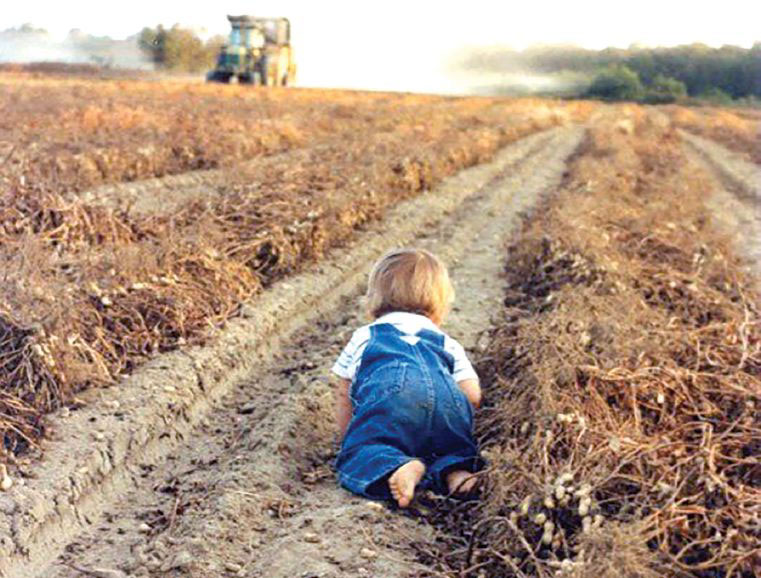
There’s one old picture I hold especially dear. It’s a family favorite. A framed copy hung for years in the sitting room of my grandma’s house. I can’t be more than a couple of years old. My hands and knees plow the fine, loamy ground. My hair is sandy blonde, and blue overalls encapsulate my body.
It would’ve been probably Octo-ber, evidenced by the turned peanuts nodding towards the sky, vines molt brown. They fill most of the frame. Off in the distance, a John Deere 4440 pulls a Hustler combine, and green trees are lost behind a sweeping cloud of dust. Must have been extra dry.
The most significant part of this picture, however, can’t be understood by mere observation. My father is driving that tractor, you see. My Dad. My toddler mind knew exactly where Daddy was. I was determined to be with him.
With the click of a frame, a moment in time is captured. Time marches on. That moment in time represents the never-ending love a son has for his father, the land and the precious memories planted in the ground.
I remember riding with Mom into fields on scorching days. We’d deliver cold cokes and sandwiches to Dad, his shirts saturated with sweat and on the verge of resembling a Pollock painting, stained by the dirt and grease he’d absorbed.
Another memory involves an orphaned calf Dad rescued and nurtured. Useless and small as I was, Dad allowed me to “assist,” holding a bottle of milk to the calf’s mouth as it desperately drew the sustenance which flowed from its nipple. More than anything, I remember simply “riding the land.” While Dad drove his truck, the passenger’s side dashboard would become my drum kit as “Golden Oldies” from Cruisin’ 94 escaped the speakers. If we were so fortunate for “Peggy Sue” to play, Dad would never fail to offer up his best Buddy Holly impression.
Farming is, or should be, a way of life. As a calling and vocation, it is completely set apart in that one works with divinely created land, land that has been here for millennia and will remain once we’ve met our maker. Farming is a partnership with God in the purest sense. No matter the science or technological advancement, in the final analysis, the farmer remains utterly dependent on forces outside himself.
The farmer handles his responsibilities, he prays and he waits. The process repeats. Farmers joke about never being satisfied. You’ll never meet a satisfied farmer, they say. It’s too hot or too cold. It’s too dry or too wet. But the humble farmer knows who to call on and thank every step of the way.
Farmers are, by and large, some of the most faithful people on this planet. The best ones are wise and humble enough to understand the unique opportunity they are afforded and continue to grow as practitioners, while acknowledging the sovereignty God has over His creation.
Most of my farm labor growing up consisted of being a hand in summer watermelon fields north of town. I revere agriculture, but I have never farmed alongside my Dad. Sometimes this saddens me, but it is a selfish sadness, longing for the deeper respect gained between only those who experience such. Generations of Sumner men farmed and still do. My grandfather farmed with my great-grandfather. Dad farmed because it’s all he ever wanted to do, and he sought to continue the legacy of his next of kin.
Baseball was the love of my youth. When I should have been paying attention in class, I often daydreamed of the day I’d hit a walk-off grand slam to win the World Series. Overlooking a portion of the family farm stood a batting cage where Dad devotedly threw pitch after pitch, honing my skill for as long as my will demanded. If there is something that comes close to surpassing my Dad’s love for farming, it is baseball.
Perhaps it surpasses his love for farming at this present juncture. I played college ball and clung to the game, but to this day Dad’s grasp upon it is much tighter than mine.
As Jon Kohler often says, there is much to be gleaned from a backstory. Dad’s sacrifice has been my family’s reward, and for that I am forever grateful.
When tobacco went out of favor in the early 2000s, Dad had a decision to make. His rule of thumb back then was to pay off the operating expenses of the entire farm with tobacco income. Money “to live on” came from the income of other cash crops such as peanuts, soybeans, and wheat. This was the objective, with each and every natural and man-made risk considered and prayed over.
With his main cash crop under fire and a buyout imminent, economics were at play. He determined by leasing his land, combined with earnings from the buyout, he would likely make at least the equivalent of what he would by continu-ing to farm. But his decision went far beyond economics.
At the time, my paternal grandparents were rapidly declining in health. This weighed heavily on Dad’s mind, and his responsibility and duty to them was to be admired. Furthermore, my parents had been married 16 years before my birth. They were older parents relative to my age and had the self-awareness to understand the implications.
With the arrival of my teenage years, it was of the utmost importance to Dad to be more present and involved in my life. I showed great promise as a young athlete, especially on the baseball diamond, and his love for me as a father was exemplified by his sacrifice. Numerous unforgettable memories were created in the years to follow, with quite a few involving ball and bat. Dad is part of the majority of these memories. For his consistent presence, I am ever grateful.
I have visited much of our United States and traveled to parts of the world. After college, I lived in Nashville and Louisville. You can take a boy out of the country, but you can’t take the country out of the boy. There’s truth in that saying. Southerners love home. This is true of many people, yes, but place holds a much higher role in the Southern tradition. In part, place has defined the South. There is reverence for one’s ancestors.
As a Southerner with roots as deep as a white oak, there’s nowhere else I’d rather be on God’s green earth than Southwest Georgia. Specifically on family land. This land has always been my “place to come to.” It at once brings solitude and joy. It grants me independence and sufficiency I could never find in city living. I can derive livelihood from it if need be. It develops patience within me when waiting for the harvest or a good bite.
In fact, I share it with the deer and turkey, among the multitudes of God’s creatures. It makes a home for them and will continue to once I am gone. It teaches me of self-sacrifice and reminds me of the importance of community. It soothes my soul, and I long to leave it better than I found it.
For all these reasons, I seek to be a steward of the land. It is my goal to properly manage our land for years and years to come. I have a long way to go and much to learn, but I am thankful to those who have already graciously shared with me wisdom that comes only through first-hand experience.
There are numerous organizations doing fine work to protect and conserve our lands and way of life, and we have more tools and resources at our disposal than ever before. More resources mean fewer excuses. I have never taken for granted the
land I hunted and fished in my youth. The same land I so often “ride” with Dad to this day. I just didn’t fully realize what I had. All I have to do is examine the state of land ownership to recognize how blessed I am to have land of my own. I relish the responsibility and duty I have before me to manage and nurture this land. In doing so, I am honoring my ancestors, my family and, most importantly, my Lord.
I seek to maintain an intense devotion to my God, my family and my land. Remember and honor God above all else. Do not confuse the Creator with His creation. While we have a responsibility to care for every resource God has provided, the earth we inhabit is not a permanent planet. It is not eternal like the Creator. Understanding this is important to holding in balance our freedom to use the land for our benefit and our responsibility to maintain it.
Rediscover the outdoors. Hunt, fish and garden. Farm if you’re able. Take time to enjoy God’s beauty. Enjoy the forests and the waters. Thank the Lord constantly for the comforts they provide us.
I am fortunate to be in a unique position to help others conserve their lands and offer my knowledge and advice. Thank you Lord, for each and every “place to come to.” Especially mine.
Sometimes a picture is worth more than a thousand words.
 From murky farm ponds to pristine glacier-cut lakes and everything in between, Knox Daniels’ expertise stems from a lifelong fascination of water and the creatures that live in and around it. He recognizes and helps clients appreciate the value water features bring to a property. “My goal is to help buyers realize and sellers maximize the value different water bodies bring to a property, not only in a recreational sense, but also for social storm reasons.” After extensively traveling the country for collegiate BASS fishing tournaments, Knox graduated and worked for the Southeast’s finest fisheries and wildlife biologist, Greg Grimes. With Grimes’ company, AES, Knox managed many of the southeast’s finest private lake estate/impoundment properties, and learned the intricacies of upscale property management. Learning from Greg and other biologists, Knox honed in on the specific conditions and habitat needed for optimal gamefish growth in private lakes. He has also worked as a property manager on several thousand acres and for a commercial developer, facilitating the dirt work and builds of several apartment complexes, but his true passion has always been in the outdoors. “I’ve always had an insatiable fascination with ponds/lakes and am grateful to be able to help to place clients on the properties of their dreams and make their personal fisheries/wildlife goals reality with JKA.” – Knox Daniels
 Jason has been assisting landowners for the last 28 years in Georgia and South Carolina obtain achievements the owners did not realize were possible. His degree in Biology from Georgia Southern stemmed from the desire to know how things in nature work. His plantation roots began at just 16 years old outside of Albany, GA and the last 20 years were spent in the Lowcountry of South Carolina. His entire career has been spent developing a global approach to plantation management. That plan included sales. Sales is in Jason’s blood- his mom had a 45-year career as a real estate broker. After college, he chose to pursue his passion of making properties great. In 2011, Jason sold his first plantation. Since then, he has assisted buyers and sellers with over $20 million in sales while most of that time working as a full-time General Manager of a large Lowcountry plantation. Today, he is committed to using his unique skill set and experience to guide landowners through the many challenges of plantation ownership.
 Bruce Ratliff is a retired elected official (Property Appraiser Taylor County). Bruce brings years of experience in ad valorem tax knowledge. His property tax background gives JKA Associates & clients a unique insight into the complicated tax process. Bruce held several positions in the Florida Association of Property Appraisers, including member of the Board of Directors, President, Vice-President and Secretary, and served on the Agricultural & Legislative Committees for the Association. The real estate business has been part of Bruce’s life since childhood. His mother, Shirley Ratliff owned Professional Realty of Perry, Florida and his father, Buster owned Ratliff Land Surveying which Bruce was General Manager of before his political career.
 Hailing from a long line of outdoorsmen, Tim learned a great deal from his father and grandfather. He saw first-hand what it means to be a good land steward. He believes land is so much more than a place to hunt, fish, and grow timber or crops. “It’s an identity, a resting place, a safe haven and a way of life, said Tim.” Tim’s family ties to Alabama run deep. During his grandfather’s first term, Governor James was responsible for signing into law Alabama’s first state duck stamp which helped to ensure funding for the procurement, development, and preservation of wetlands for migratory waterfowl habitat. He also established Alabama’s lifetime hunting license, so it is no surprise that Tim is an avid outdoorsman with a keen eye as to how best to improve habitat for the greater good of its wildlife.
 With Madison County roots, Lori grew up on her family farm at Pettis Springs along the historic Aucilla River. A love of the land was instilled in Lori very early on by her father who was a local farmer. Lori understands the importance of good land stewardship and has witnessed first-hand how her own father, a former 2-term member of the Florida House of Representatives whose district encompassed many rural counties of the Red Hills Plantation Region, with a little bit of sweat equity, so lovingly worked their own family land. These are core values she carries with her today, and nothing gives her more personal satisfaction than to represent some of the south’s best land stewards.
 Cole’s dedication to land management lies in his family roots. As a fourth-generation timber expert, Cole’s earliest memories were spent with his father managing timber investments. With a degree in Food Resource Economics from the University of Florida, Cole is the epitome of an up-and-coming leader. He grew up with a hands-on approach to learning land management and conservation and has spent the last 15 years learning every angle of the real estate and forest industry. Cole is a member of the Florida Forestry Association, Red Hills Quail Forever, Southeastern Wood Producers Association and he uses this platform as an advocate for landowners and their land investments. His family has dedicated the past 60 years to providing landowners in North Florida and South Georgia with professional land management services focused on improving and protecting one’s forestland and wildlife investment. In fact, their family business, M.A. Rigoni, Inc., was one of the first to introduce whole tree chipping to the Red Hills Region.
 As a landowner of his own family farm, Lick Skillet, along with family land that has been passed down and enjoyed together at Keaton Beach for 40 years, Jon knows what it means to be a steward of the last best places. As a third-generation land broker with more than 30 years of experience in advising landowners in this niche, Jon is known for his innate ability to harvest a land’s unique intrinsic value. Touting several notable sales under his belt, Jon personally closed Rock Creek/Molpus – 124,000 acres of premium timberland at $142,000,000 – which was known as the largest timberland land sale in the Southeast for eight years running. He is a co-founding member of LandLeader and achieved the real estate industry’s highest honor, “2022 National Broker of the Year – Recreational Land Sales,” by the Realtors® Land Institute.