
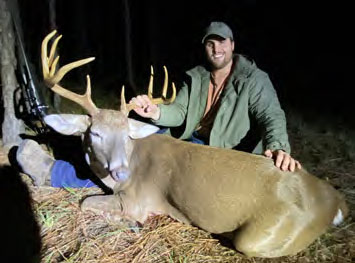
Florida and Georgia have a competitive relationship whether it’s the “Georgia / Florida football game” or the “Florida / Georgia football game” or, in my world as a land broker, the competition between which state can claim the best hunting lands. In my observation, that boils down to two points of contention: one state claims world-class trophy bass and the other, the largest trophy Whitetails in the South. Not all that long ago, the deer in both states were about equal. However, the backstory of how Georgia got its trophy deer is a classic case of atonement and redemption.
Floridians can take pride in knowing that the “Florida Strain” largemouth bass is the no.1 trophy bass genetic in the world – not just the Southeast, the world. This strain holds several world records, with one of the record strains harvested in Southwest Georgia in 1932. The strain was even transplanted to Japan, which holds the current world record caught in 2009. Both these fish weighed in over 22 lbs. However, new research has now shown that the “Florida strain” naturally extends up into Southwest Georgia. I guess it’s too late to call it the “Florida / Georgia Strain” so perhaps like an undeserved score in college football, it’s still on the board for Florida.
However lucky Florida is in getting its name on the best bass genetic in the world, it may be just as unlucky with the Whitetail genetic, of which today’s Georgia dominates. Hands down. Headlines like “Florida-strained bass changed the world of bass fishing” have never been said about Florida’s deer.
More B&C Whitetails have come from Georgia than any other Southern state and that number grows every year. Georgia currently has 95 all-time B&C entries. I personally have clients who no longer enter the registry over privacy concerns, so the actual number is even higher than the recorded count.
Meanwhile, Florida has only six sporadic B&C entries. However, like bass, a lot of places in Florida and Georgia historically share a similar natural Whitetail genetic. Given the choice of harvesting a 170-inch buck or a 15 lb. bass, I’m going with the buck 100% . . . so what happened to Florida?
For most of its history, Florida had better success in protecting the deer herd, and ironically that’s what set it back. It’s not as if our Florida genetic is “pure” like say the Coues Deer subspecies in Texas. In most of Florida, like the rest of the South, deer of all types have been brought in from other regions to restock over-harvested populations. Aside from a few places like Georgia’s coastal islands or South Florida, most everywhere else has outside genetics.
A dollar bill first got the nickname a “buck” because a deer hide was worth one dollar. At a buck a piece (and without the wild lands of Florida) it didn’t take long for deer to become extinct in most of Georgia. Thus, when improved deer were brought into Georgia, the genetics were not diluted.
Generations of Georgians grew up never seeing a deer and for a while, there was almost no culture of deer hunting. The credit for who started the spark for what is now Southwest Georgia’s pride is given to one person. One would think that across Georgia that person’s name would be more famous than Ohio’s own Johnny Appleseed. Both made a difference. Georgia has its own Ranger Arthur Woody to thank, the year would be 1927 and one couldn’t find a more likable person. He was Georgia’s second Forest Ranger. He had his hand in early fire, wild turkey restocking, virgin forests, trout stocking, lake building, and he loved the mountain people and God.
Even his dad’s name “Abraham Lincoln Woody” sounds like a name in a script from a John Wayne movie. In my business, I know the reason most folks buy recreational land is that, when they were at an impressionable young age, they saw someone they admired working or enjoying the land and a spark was started. I call it developing a reverence. Legend has it that 11-year-old Woody was out on a deer hunt when his dad shot a monster buck. He was told that was the last big buck and he would never see another. At that very moment, that spark started and would burn for the rest of his life, almost unknowingly hypnotizing him. His life’s goal was to see to it that this wouldn’t be Georgia’s last big buck. He started with two circus bucks from Wisconsin and grabbed five doe fawns from North Carolina. Back then, you didn’t go to prison for transporting live deer across state lines.
He started releasing his deer in what would later become the first WMA and the released deer quickly grew to an estimated 2,000. With almost zero predators, his timing couldn’t have been better. Bears were long gone. Georgia’s last Red Wolf (the no. 1 deer predator) was shot near the Okefenokee in 1908, twenty years earlier. It would be another 43 years before the first coyote took advantage of the void. By 1958, the screw worm was eradicated. EHD wouldn’t be widespread until the early 1970’s leaving neither major predator nor disease.
The early lack of sophistication, backed by country ingenuity, is precisely why today some Georgia counties have the genetics to consistently produce B&C record book bucks and some don’t. Other than Woody’s “Blue Ridge herd,” deer were extinct throughout Georgia except in the hard-to-reach Coastal islands. Catching deer is not easy. They tried using dogs to chase deer across salt marshes into nets. They tried box traps. The Director of the Wildlife Resources Division, Jack Crockford, personally developed the dart gun! After much effort, it was determined that most of this was too difficult and costly in man-hours. Of the 3,471 deer stocked 1,819 were trapped from Georgia’s coastal islands before they called that quits. Later, Crockford determined that it made more sense to simply buy the deer. In 1960, using “Pittman Robertson” money, they paid $35 a head for readily available Texas or Wisconsin deer. It was a deal. That’s when Southwest Georgia really got lucky.
Texas deer were thought to carry screw worms, which couldn’t survive the cold of North Georgia, so they were sent north as a precaution. Therefore, SW Georgia got the best genetics, those from Babcock, Wisconsin. In what would amount to the financial “investment of the century” Southwest Georgia landowners joined in too, in the
form of the Worth County Wildlife Club. Their 124 “Babcock” deer would later catapult Worth and surrounding counties into a 2022 deer hunting land boom. Can you imagine going back in time and trying to exclaim to them that in the future we would be consistently selling top deer hunting land at values close to or even exceeding irrigated farmland values?
One can quickly look at today’s top B&C counties and see pretty much exactly where the Wisconsin deer were initially released 60 years ago. Worth County is in the middle of it all, so are the land values. They had no way to comprehend the massive financial benefits of their conservation efforts.
The superior genetics combined with Georgia’s fertile soils and cropland gave the deer the nutrition to reach their full potential. Additionally, the hunting culture started anew, this time respecting age and size over quantity. Thus, unlike in many areas, hunters in SW Georgia grew up knowing the benefits of letting them go so they can grow. When one harvests a 341 lb. buck in Dooley County or harvests a 170-inch monster, (like several of our clients have), that’s something special.
Genetics is the only one of the three central tenants that landowners couldn’t control. I credit solving nutrition and age to one of Georgia’s most famous visionaries, David Morris. Like Woody, David has not only an unbridled passion for deer, but he also loves Jesus, and with that comes a love for sharing with others. Just as a good disciple, David knows how to spread the word. Hunters across the South took notice.
David spent years managing and studying deer in the famed 12,000-acre Burnt Pine Plantation where he oversaw the harvest of 2,000 deer. Many people are curious, and many are observers, but finding someone that could be both and develop new conclusions or “rules” is rare. David is that person for mature Whitetails. He literally wrote the original rule book on “Hunting Trophy Whitetails.” He published the no. 1 deer magazine, “North American Whitetail,” that shared his rules on the secrets to nutrition and age. He went on to pioneer an entirely new way to grow and manage Whitetails through his brand Tecomate. His TV Show “Bucks of Tecomate” is still one of the top hunting shows out there.
With David Morris, along with fellow Georgians Dr. Larry Marchinton and Dr. Karl Miller, preaching that we could consistently grow big bucks if we had 1) nutrition 2) age, and 3) genetics – Southwest Georgia could now have it all. Sportsmen have finely honed the skills of raising mature Whitetails to the maximum of their ability. Today, while the Florida Strain Largemouth bass can be stocked about anywhere, the same simply does not hold true for deer. What’s done is done. What was once the worst of wildlife sins – the local extinction of a species – has certainly been atoned for. The redemption of which turned Georgia into a trophy deer hunting paradise in ways it never had been before.This may seem like the end of the debate, except that today’s Florida landowner’s have their own
“Ace in the hole.” You see on Florida’s private land’s, unlike Georgia, many are able to get permits to breed and develop one’s own genetically improved herd, using today’s latest science. These deer are bigger than anything that ever came out of Wisconsin, but that’s a story for another day . . .
 From murky farm ponds to pristine glacier-cut lakes and everything in between, Knox Daniels’ expertise stems from a lifelong fascination of water and the creatures that live in and around it. He recognizes and helps clients appreciate the value water features bring to a property. “My goal is to help buyers realize and sellers maximize the value different water bodies bring to a property, not only in a recreational sense, but also for social storm reasons.” After extensively traveling the country for collegiate BASS fishing tournaments, Knox graduated and worked for the Southeast’s finest fisheries and wildlife biologist, Greg Grimes. With Grimes’ company, AES, Knox managed many of the southeast’s finest private lake estate/impoundment properties, and learned the intricacies of upscale property management. Learning from Greg and other biologists, Knox honed in on the specific conditions and habitat needed for optimal gamefish growth in private lakes. He has also worked as a property manager on several thousand acres and for a commercial developer, facilitating the dirt work and builds of several apartment complexes, but his true passion has always been in the outdoors. “I’ve always had an insatiable fascination with ponds/lakes and am grateful to be able to help to place clients on the properties of their dreams and make their personal fisheries/wildlife goals reality with JKA.” – Knox Daniels
 Jason has been assisting landowners for the last 28 years in Georgia and South Carolina obtain achievements the owners did not realize were possible. His degree in Biology from Georgia Southern stemmed from the desire to know how things in nature work. His plantation roots began at just 16 years old outside of Albany, GA and the last 20 years were spent in the Lowcountry of South Carolina. His entire career has been spent developing a global approach to plantation management. That plan included sales. Sales is in Jason’s blood- his mom had a 45-year career as a real estate broker. After college, he chose to pursue his passion of making properties great. In 2011, Jason sold his first plantation. Since then, he has assisted buyers and sellers with over $20 million in sales while most of that time working as a full-time General Manager of a large Lowcountry plantation. Today, he is committed to using his unique skill set and experience to guide landowners through the many challenges of plantation ownership.
 Bruce Ratliff is a retired elected official (Property Appraiser Taylor County). Bruce brings years of experience in ad valorem tax knowledge. His property tax background gives JKA Associates & clients a unique insight into the complicated tax process. Bruce held several positions in the Florida Association of Property Appraisers, including member of the Board of Directors, President, Vice-President and Secretary, and served on the Agricultural & Legislative Committees for the Association. The real estate business has been part of Bruce’s life since childhood. His mother, Shirley Ratliff owned Professional Realty of Perry, Florida and his father, Buster owned Ratliff Land Surveying which Bruce was General Manager of before his political career.
 Hailing from a long line of outdoorsmen, Tim learned a great deal from his father and grandfather. He saw first-hand what it means to be a good land steward. He believes land is so much more than a place to hunt, fish, and grow timber or crops. “It’s an identity, a resting place, a safe haven and a way of life, said Tim.” Tim’s family ties to Alabama run deep. During his grandfather’s first term, Governor James was responsible for signing into law Alabama’s first state duck stamp which helped to ensure funding for the procurement, development, and preservation of wetlands for migratory waterfowl habitat. He also established Alabama’s lifetime hunting license, so it is no surprise that Tim is an avid outdoorsman with a keen eye as to how best to improve habitat for the greater good of its wildlife.
 With Madison County roots, Lori grew up on her family farm at Pettis Springs along the historic Aucilla River. A love of the land was instilled in Lori very early on by her father who was a local farmer. Lori understands the importance of good land stewardship and has witnessed first-hand how her own father, a former 2-term member of the Florida House of Representatives whose district encompassed many rural counties of the Red Hills Plantation Region, with a little bit of sweat equity, so lovingly worked their own family land. These are core values she carries with her today, and nothing gives her more personal satisfaction than to represent some of the south’s best land stewards.
 Cole’s dedication to land management lies in his family roots. As a fourth-generation timber expert, Cole’s earliest memories were spent with his father managing timber investments. With a degree in Food Resource Economics from the University of Florida, Cole is the epitome of an up-and-coming leader. He grew up with a hands-on approach to learning land management and conservation and has spent the last 15 years learning every angle of the real estate and forest industry. Cole is a member of the Florida Forestry Association, Red Hills Quail Forever, Southeastern Wood Producers Association and he uses this platform as an advocate for landowners and their land investments. His family has dedicated the past 60 years to providing landowners in North Florida and South Georgia with professional land management services focused on improving and protecting one’s forestland and wildlife investment. In fact, their family business, M.A. Rigoni, Inc., was one of the first to introduce whole tree chipping to the Red Hills Region.
 As a landowner of his own family farm, Lick Skillet, along with family land that has been passed down and enjoyed together at Keaton Beach for 40 years, Jon knows what it means to be a steward of the last best places. As a third-generation land broker with more than 30 years of experience in advising landowners in this niche, Jon is known for his innate ability to harvest a land’s unique intrinsic value. Touting several notable sales under his belt, Jon personally closed Rock Creek/Molpus – 124,000 acres of premium timberland at $142,000,000 – which was known as the largest timberland land sale in the Southeast for eight years running. He is a co-founding member of LandLeader and achieved the real estate industry’s highest honor, “2022 National Broker of the Year – Recreational Land Sales,” by the Realtors® Land Institute.