
by Jon Kohler, JD
Some of America’s finest architects have left their mark on the South, but few people understand the relationship between land and architecture as deeply as my friend Bill Thomas.
A fourth-generation James Islander and graduate of The Citadel – where he also played football – Thomas carries with him the cadence and warmth of a true Charleston native. His voice recalls a time when life moved slowly enough to savor iced tea on the porch beneath ancient oaks.
“In our world, what we did in the Lowcountry was to create a recreational tract of land where we incorporated deer hunting, turkey hunting, a sporting-clays facility and a pavilion on a half-acre pond that added a great aesthetic to the property,” Thomas said. “In Charleston, you have a nine-month outdoor place. January can be tough, and so can July and August. Otherwise, you can enjoy nature for much of the year.”
The Land Shapes the Architecture
Few regions embody a sense of place more strongly than the Lowcountry. Over generations, extended outdoor living gave rise to its own vernacular. Places like the South Carolina Low country, Middle Georgia and the Florida coast each developed architectural traditions shaped by their landscapes.
“I don’t know if others see it,” Thomas said, “but the style of architecture takes its base from the quality of the land. I was showing land the other day and noted to the client to watch the architectural styles change as the quality of the soil changed.”
In the past, wealth came from the bounty of the land. Fertile soils and access to shipping created extraordinary wealth in towns across the South. In turn, remarkable homes were built and were testaments to prosperity, crafted with detail few carpenters or budgets could match today. Drive only a few miles, and as the soils thin, so too does
the architecture, becoming simpler, less inventive.
“It’s a shame this is long gone,” Thomas said. “It’s unrealistic to think it could come back.”
Architectural Legacies and Sporting Estates
Today’s landowners often seek to create something meaningful – something that will outlast them. Architecture has become both a reflection of place and a stage for entertaining, a statement of wealth, taste and legacy.
Sometimes the results are astonishing. The largest log cabin east of the Mississippi, for instance, stands not in the mountains but in a North Florida longleaf forest, its Canadian logs milled in Montana before finding their home (with a 22-car garage) along a ginclear creek.
Few realize that the Southern sport of quail hunting was introduced by former Yankees. By the time hunting plantations emerged as today’s asset class, the old cotton plantations had been gone for more than 20 years. While classical revival architecture remains popular, very few original antebellum plantation homes exist on modern hunting properties.
Yet, exceptions endure. Judge Morton, who created Morton Bray Plantation in 1843, commissioned John Wind – architect of Greenwood, Susina and Pebble Hill. Stanford White once declared Greenwood “the most perfect example of a classic revival home in America,” cementing both Wind’s reputation and the prestige of the Red Hills.
A generation later, across the street, Jack Archbold, vice president and heir to Standard Oil, built Chinquapin Lodge – an emblem of industrial wealth set against Southern sporting tradition.
I’ve had the privilege of representing many such estates. Morton Bray Plantation has changed hands three times under my brokerage, including a sale to Virgil Williams, who restored its ante-bellum home to near-museum quality. I also sold Williams’s 7,000-acre Heritage Plantation, which included the meticulous relocation and restoration of Camellia Hall. That sale required only one call to my Rolodex and achieved full price.
As I travel the rural South, I can almost feel the history – what people went through – just by looking at the architecture.
All of these regions boast remarkable architecture, but only in the Lowcountry can one glance at a home and immediately recognize its place.
And I’ve long observed: “There are people who have a passion for architecture and people who have a passion and an eye for managing land. It is almost never the same person.”
Examples abound. On Black’s Island in St. Joe Bay, Deltec homes were brought into what was once pirate Black Sam Bellamy’s hideout, with power lines run beneath the water. Against all odds, those homes survived a Category 5 hurricane, much like the famous Forrest Gump scene where only Jenny’s house endured – an event dramatic enough to be featured on The Weather Channel.
Elsewhere, Oak Hill is celebrated as one of the most historically accurate reproductions of classical revival design, while Old Fields provides another faithful interpretation. Enon and Chad-wick showcase carefully restored cabins that honor their frontier past, while Setter Run and Chadwick incorporate Appalachian style architecture, blending rugged authenticity with a sense of permanence. Together, these properties illustrate how history, land and vision continue to shape the South’s most enduring architectural legacies.
From Entrepreneurship to Land Stewardship
Thomas’ journey blends entrepreneurship with stewardship. After earning his degree in the 1970s, he began his career as a textile production supervisor in Virginia, earning a modest $13,000 salary. Yet he always knew he would chart his own business path.
“I’ve grown and sold several businesses since then,” Thomas said. “I enjoy finding the missing links and developing a way to fill them.”
His career later included five years with Abbott Laboratories in Europe, before returning to Charleston in 2001. There, he launched PortWatch Group, a logistics, trucking and warehousing
firm, while also pursuing his deeper passion: shaping land in ways that reflect the region’s plantation traditions.
The Birth of Thomas Hall
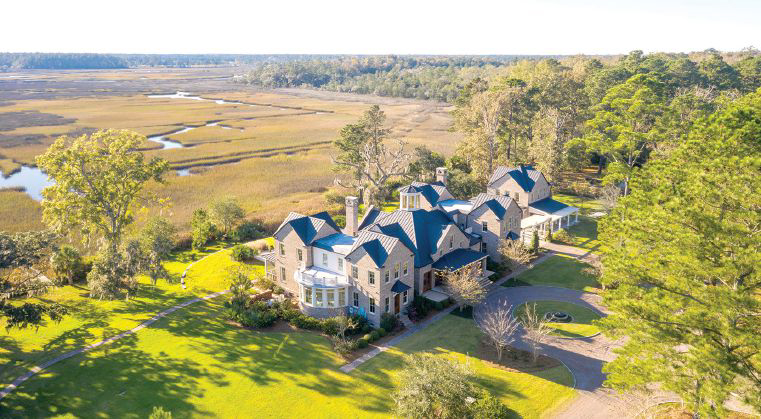
Soon after returning, Thomas ac-quired a parcel of land along Rantowles Creek, 13 miles south of downtown Charleston. Over time, that property became Thomas Hall, a 125-acre estate.
“My wife and I wanted a place to teach our three sons the value of outdoorsmanship – a place where people could gather and enjoy themselves in the sporting life as well as in quiet, tranquil surroundings,” Thomas said.
Working with an architect, the Thomases envisioned a home that paid homage to classic plantation architecture. “We believe it’s a traditional construction type with an emphasis on a plantation home with brick-tapered columns that mirror some of the traditional designs,” Thomas said.
Their architect encouraged them to call it a “Hall,” and the name stuck.
History Preserved
The land’s history stretches back to the 1770s, when it was part of Grayton Hall’s 20,000-acre holdings. After the Civil War, investor John Bradley purchased it for phosphate production.
In 1969, developer Speedy Falco proposed carving canals into the old
rice fields for a South Florida–style sub-division of 144 homes. Thankfully, the plan never materialized. Today, those 60 acres of rice fields remain protected on the historic registry, preserved for future generations.
Even during construction, reminders of history emerged: horseshoes un-earthed during septic work connected Thomas Hall to the lives once lived on the land.
A Sanctuary of Leisure and Nature
Today, Thomas Hall blends nostalgia, nature and plantation inspired architecture. Its 7,300-square-foot main house overlooks preserved rice fields and marshland. The estate also includes an outdoor pavilion, detached living quarters, a fishing pond, a skeet shooting facility and direct access to the Intracoastal Waterway.
Though private, it lies less than 20 minutes from downtown Charleston, surrounded by county land for privacy and protected under a Ducks Unlimited conservation easement – part of nearly one million acres safeguarded in South Carolina.
“The possibilities for outdoor enjoyment are endless at Thomas Hall,” Thomas said. “The hunting is bountiful, the land is beautiful, and access to the waterways – and Shark’s Tooth Island – is easy. For younger generations, it in-stills confidence and pays dividends in society going forward.”
Defining Plantation Architecture
carries hallmarks born of both history and climate. Wide, columned porches – or piazzas – captured breezes and provided shade. Symmetry lent order, while tall windows and raised foundations responded to humidity and flooding. Brick and wood grounded these homes in their landscapes, with grand entryways designed to welcome. Above all, plantation homes were built to connect indoor life with the outdoors – a philosophy carried forward at Thomas Hall.
On to the Next Chapter
When it came time to sell Thomas Hall, Thomas and his wife turned to Erica and me.
“The Kohlers have a great team and a different mindset,” Thomas said. “They were very helpful with guiding, directing and networking. They’re just good people.”
We sold Thomas Hall for $6 million dollars to a Florence businessman. Thomas has since purchased 103 acres for his next recreational homesite, continuing a pattern I see growing across the Lowcountry.
“There’s a lot of diversity here,” Thomas said. “Great beaches, rivers, hiking and biking – it’s a great foundation. A lot of people are moving to Charleston, Beaufort and Savannah. They believe it’s a bit of paradise.”
Today, Thomas lives next door to his former estate and is already envisioning his next project. And he told me: “When the time is right for a real estate transaction, you’ll be the first guy I call.”